HR strategy often runs in parallel to business strategy, rather than connected to it. Talent intelligence is what creates the link — by making workforce capability visible as a business input, not just an HR metric.
Skills-based workforce planning replaces headcount forecasting with capability forecasting. This article explains what it is, how it differs from traditional approaches, and what it requires to work.
Enterprise talent risk is rarely where leaders expect to find it. This article outlines the four workforce risks that are consistently underestimated — and what makes them visible before they affect business performance.
Long time-to-fill on critical roles is not just a sourcing problem. It is a visibility problem. Here is what is actually slowing the process and what changes when internal capability is structured and searchable.
Skills gaps are visible in hindsight. This article explains how to identify them early — using structured skills data rather than waiting for performance or business problems to surface them.
CHROs in 2026 are being asked to do more than manage HR operations — they are being asked to build a workforce that can move with the business. Here are the decisions that matter most.
Workforce agility is not a flexibility policy. It is the ability to move the right capability to the right problem, fast. Most organizations cannot do it — here is why.
Most organizations default to external hiring for critical roles — not because internal talent doesn't exist, but because it's invisible. Here's why internal hiring breaks and what changes when it doesn't.
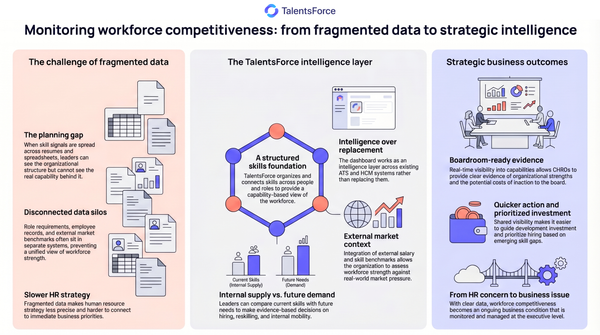
Workforce competitiveness is not just headcount. TalentsForce brings skills data, role requirements, and external market benchmarks into one intelligence dashboard — so leaders can plan with confidence.
A TalentsForce use case showing how skills supply and demand visibility helps workforce planning move from reactive response to clearer workforce action.