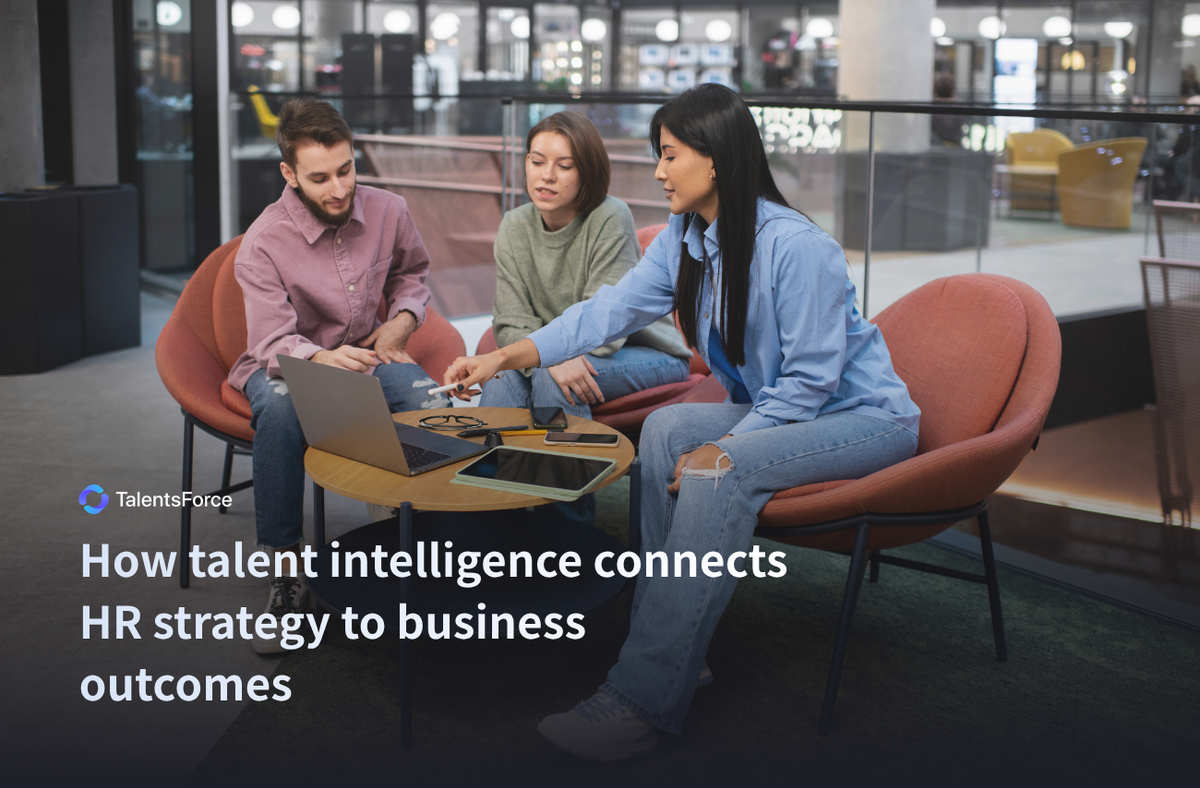
How talent intelligence connects HR strategy to business outcomes
HR strategy often runs in parallel to business strategy, rather than connected to it. Talent intelligence is what creates the link — by making workforce capability visible as a business input, not just an HR metric.
Talent intelligence connects HR strategy to business outcomes by making workforce capability visible as a structured data input — not a general assumption. It translates business strategy into specific capability requirements, maps those requirements against what the workforce currently holds, and makes the gap concrete. When that data exists, HR strategy stops describing intentions and starts demonstrating a measurable plan tied to business priorities.
There is a gap that almost every HR leader has encountered — and that very few can close completely.
The business has a strategy. HR has a plan. The two are described as aligned. But when a senior leader asks "will our workforce be able to execute this?", the response is usually some version of general confidence — supported by investment arguments rather than specific capability data.
This gap — between HR strategy and a demonstrated connection to business outcomes — is not a messaging problem. It is a data problem. HR strategy cannot be credibly connected to business outcomes if the capability data that would make the connection concrete does not exist in a structured, usable form.
Talent intelligence is what creates that data. And with it, the connection between HR strategy and business strategy stops being asserted and starts being shown.
Why HR strategy and business strategy so often run in parallel
In most large organizations, business strategy and HR strategy are developed in proximity but not in full integration. The business strategy defines markets, investments, and priorities. The HR strategy defines hiring plans, capability programs, and people priorities. The two are reviewed against each other and described as aligned.
The problem is that alignment, in this context, typically means both strategies are pursuing compatible goals — not that one is derived from or grounded in the other. HR strategy is rarely built from a specific, quantified view of what the business strategy requires at the capability level.
This produces plans that run in the same direction but are not calibrated against each other. The business strategy assumes a level of workforce capability. The HR strategy assumes that the planned hiring and development programs will produce it. Neither assumption is tested against structured data.
The connection is narrative. Talent intelligence makes it structural.
What the connection actually requires
For an R strategy to connect to business outcomes in a concrete, demonstrable way, three things need to be true.
Business requirements must be translated into capability terms. A strategy that says "expand into three new markets in 18 months" implies specific skills requirements: People who understand those markets, people who can build the customer relationships required, and people who can manage operations in new geographies. Those requirements need to be made specific — not as role counts, but as capability needs.
The current workforce capability must be known. The organization needs a structured, current view of what skills exist, where they are concentrated, and at what level of proficiency. This is the skills inventory — not a résumé archive, but a consistent, searchable map of actual capability.
The gap between the requirement and supply must be visible. Once capability requirements are specific and the current supply is mapped, the gap becomes concrete: This capability is sufficient, this one is undersupplied, this one does not exist in the organization at all. This gap view is what makes it possible to show how HR plans address business-critical needs — and which ones do not.
When these three are in place, the conversation between HR and business leadership changes. It moves from "our programs are designed to support the strategy" to "our current capability is here, the strategy requires this, and here is the plan to close the gap by this date."
What talent intelligence makes possible for HR leaders
Talent intelligence — the practice of turning structured workforce skills data into decisions — changes the position of HR in the strategic conversation in three specific ways.
From reporting to forecasting. Traditional HR reporting describes what has happened: how many people were hired, what the turnover was and what the training costs amounted to. Talent intelligence allows HR to show what is coming: Where capability gaps will emerge relative to business priorities, which roles will be hardest to fill, and which development programs are producing the skills the business will need next. Forecasting earns a different quality of attention in a strategy conversation than reporting does.
From defending investment to demonstrating impact. When HR investment in learning, hiring, or development is connected to specific skills gaps that are tied to specific business outcomes, the case for that investment is grounded in business logic rather than HR judgment. The argument stops being "we believe this will help" and becomes "this gap exists, this program closes it, and this is what the business gains when it closes."
From workforce as HR concern to workforce as business input. When capability data is visible in the same quality and currency as financial or operational data, the workforce becomes a real input to business planning — not a constraint that the business works around. Leaders can model scenarios: if we pursue this strategy, here is what we need; if we pursue this one, here is what we have. Capability becomes a factor in strategic choice, not just an execution challenge.
How TalentsForce creates the data layer HR strategy needs
The TalentsForce approach builds the infrastructure that closes the gap between HR strategy and business outcomes.
The skills foundation creates a consistent, structured view of workforce capability. Every role is defined by the skills it requires. Every employee profile reflects the skills they hold. The vocabulary is shared across functions, which makes comparison possible.
The Intelligence in Action pillar provides the connection to business planning. Skills supply-and-demand analysis compares what the workforce holds against what business priorities require — giving HR leadership a specific, quantified view of where the strategy is supported by current capability and where it is not.
Predictive analytics model forward: Given planned hiring, development, and expected attrition, how will capability supply compare to projected demand in 12 or 24 months? This is the forward-looking layer that lets HR leadership participate in strategic conversations with data rather than estimates.
Market benchmarking contextualizes the internal view: How does the organization's capability profile compare to external availability, and where is it building a skills advantage the business can rely on?
The result is an HR function that can show — not just describe — how its strategy connects to business performance. That shift changes how HR leadership is perceived, what decisions it is included in, and what influence it has over the choices that shape business outcomes.
Common questions
What is talent intelligence, and how does it connect to HR strategy? Talent intelligence is the practice of turning structured workforce skills data into decisions. It connects to HR strategy by providing the data layer that makes capability planning concrete: What skills the business needs, what skills the workforce has, and where the gap requires HR action. Without that data, HR strategy describes intentions. With it, HR strategy describes a measurable plan.
Why do most HR strategies fail to demonstrate a clear connection to business outcomes? Because the capability data that would make the connection concrete typically does not exist in a structured, usable form. HR has plans. The business has a strategy. Without a skills-level view of what the strategy requires and what the workforce holds, the connection between the two is an assertion rather than a demonstration.
What is the difference between HR metrics and talent intelligence? HR metrics describe what has happened in the workforce: Headcount, turnover rate, time-to-hire, and training completion. Talent intelligence produces a forward-looking view of what the workforce can do and what it needs to become — structured around skills, connected to business priorities, and designed to inform decisions rather than report on past activity.
How does a CHRO use talent intelligence in a board conversation? By translating workforce capability into the language of business risk and readiness. Instead of reporting HR program outcomes, a CHRO with talent intelligence data can show: Where current capability supports strategic priorities, where gaps create execution risk, and what the plan is to close the most critical gaps by when. This moves the conversation from HR reporting to strategic input.
How long does it take to build the data foundation for talent intelligence? The most significant investment is in building the skills foundation: Standardizing how skills are defined across the organization and mapping them against roles and employee profiles. The TalentsForce approach compresses this by starting from a pre-built skills database of over 70,000 skills, significantly reducing the time to first usable intelligence output.
Related reading
- What is talent intelligence and why it matters in enterprise HR
- Skills-based workforce planning: what it means and how it works
- Talent intelligence platform vs HCM: what's the difference and when you need both
When the connection between HR strategy and business outcomes is still asserted rather than demonstrated, the TalentsForce approach builds the data layer that makes it concrete.
→ See how TalentsForce works for enterprise HR
Para valorar camisetas de fútbol en línea con criterios claros, es recomendable revisar la talla, el material y el uso previsto. Una revisión final debería incluir las instrucciones de cuidado y cualquier límite aplicable a la personalización.