
What is talent intelligence and why it matters in enterprise HR
Talent intelligence is the practice of turning workforce skills data into decisions. Learn what it is, how it works, and why enterprise HR teams are building on it.

Most large organizations have more workforce data than they know what to do with. Performance reviews. Hiring records. Training completions. Years of headcount reports.
And yet, when a CHRO is asked "are we ready for what comes next?" — the honest answer is often: we don't know.
Not because the data is missing. Because the data is not organized around the question that matters: what can our workforce actually do right now, and what does it need to become?
That is the problem talent intelligence exists to solve.
What talent intelligence is
Talent intelligence is the practice of structuring workforce skills data so that organizations can make better decisions — about who to hire, who to move, what to develop, and where the gaps are.
It is not a reporting tool. It does not count headcount or track time-to-hire. It answers a different question: what capability does this workforce have, and what does it need?
Talent intelligence works across three connected decisions: hiring the right people, moving the right people internally, and building the skills the business will need next. It connects those three decisions through a single, consistent view of workforce capability.
Why the data organizations already have is not enough
Most enterprise HR teams have data in many places. ATS records. HCM profiles. Performance ratings. L&D completions. Each system holds a piece of the picture.
The problem is that these systems do not speak the same language. A job posting defines a role one way. An employee profile describes that same person in a different way. A performance review uses different categories still. None of them is structured around skills in a consistent, comparable format.
This means the data exists, but it cannot be used to answer capability questions. You cannot search across it reliably. You cannot match a person to a role based on what they actually know how to do. You cannot see where the gaps are relative to what the business needs next.
Talent intelligence solves this by creating a shared skills layer, a structured and consistent way to define capability, across all the systems an organization already uses.
The three layers of talent intelligence
Talent intelligence is not a single feature. It is a sequence. Each layer builds on the one before it.
Layer 1 — Skills foundation
A skills foundation — meaning a structured and consistent way to define, organize, and connect skills across roles, people, and systems — is the starting point. Without it, every system uses different labels for the same capability. Job postings, employee profiles, and learning platforms each describe work in different terms. A skills foundation creates one shared vocabulary. It is what makes everything else possible.
Layer 2 — Intelligence
Once skills are structured, they can be analyzed. Organizations can see which capabilities are concentrated or scarce, where gaps exist relative to business needs, which employees are near-ready for a role, and how internal supply compares to what the market looks like externally. This is the intelligence layer — the ability to read patterns across workforce data that would be invisible without the shared foundation beneath it.
Layer 3 — Action
Intelligence without action has no value. The third layer connects what is now visible to decisions: matching a candidate to a role by skill fit, recommending a development path that closes a specific gap, surfacing an internal candidate before posting externally, and modeling future skill needs against a business plan. This is where talent intelligence reaches the business — and where its value becomes concrete.
The sequence matters. Organizations that skip the first layer find that their outputs are inconsistent and their data is not trusted. The foundation has to come first.
Who uses talent intelligence — and for what
Talent intelligence is not a single-function tool. Each enterprise persona uses it to answer a different question.
CHRO / HR Director uses talent intelligence to connect workforce strategy to business outcomes. The central question: Does this organization have the capability to execute the plan? Talent intelligence provides the visibility to answer it with confidence — not just with a report.
→ How talent intelligence supports HR strategy
HRBP / L&D Leader uses talent intelligence to make learning investments land on the right gaps. The central question: what does each person actually need to develop, and how does that connect to what the business needs next? Without a skills view, programs get built around assumptions.
→ How to identify skills gaps early — before they affect business performance
Head of Talent / TA Leader uses talent intelligence to see internal candidates before going to market. The central question: can this role be filled from inside, and can we match candidates to it by skill — not by who a manager happens to know?
→ Why internal hiring fails and what organizations can do differently
CEO / COO uses talent intelligence to understand workforce readiness as a strategic input. The central question: Is this organization building the capability it needs to stay competitive, and where is it most exposed? Talent risk is business risk.
→ What workforce agility means for business leaders — and why most organizations don't have it
How talent intelligence differs from HR analytics and HCM
These three terms come up together. They are not the same.
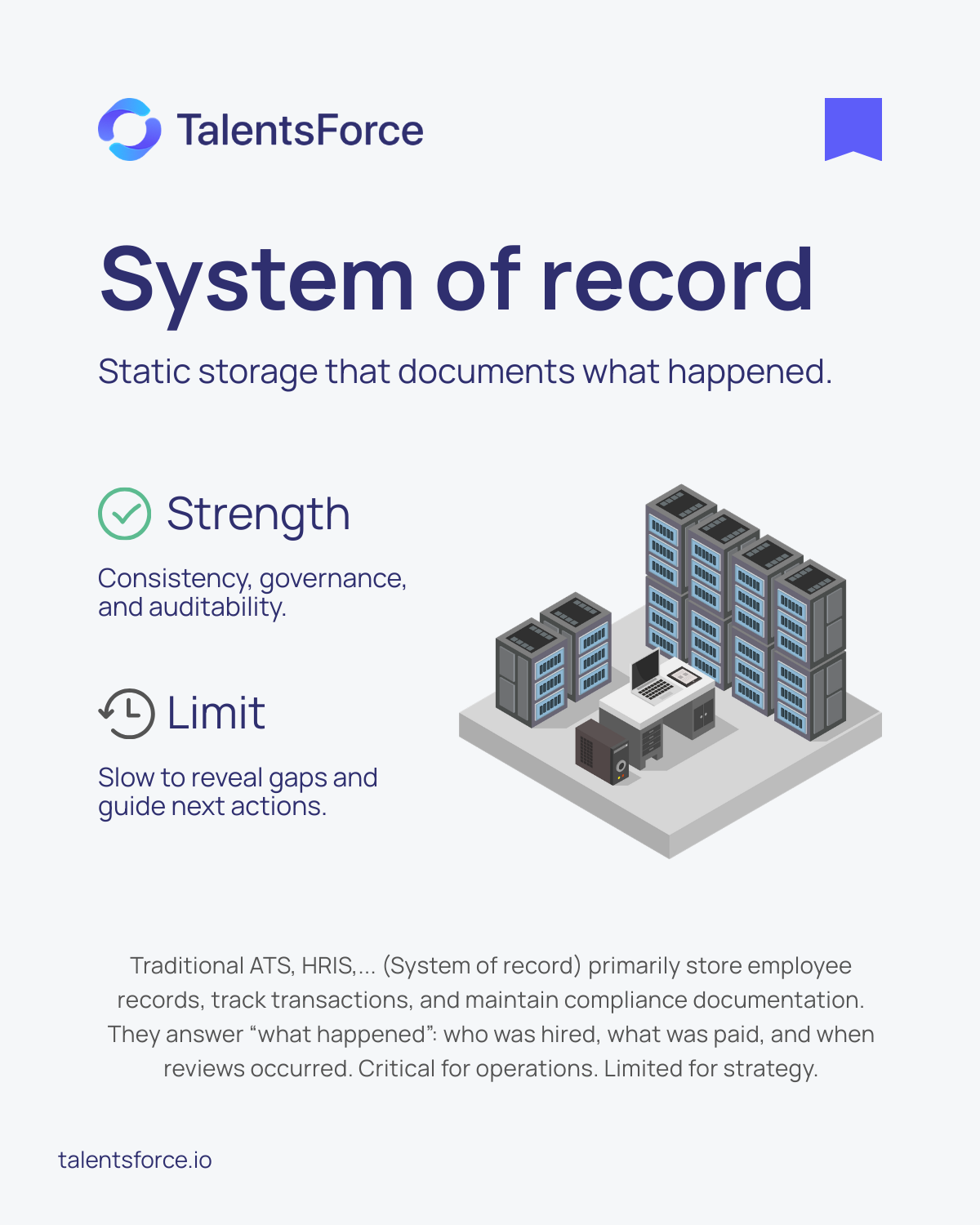
HR analytics measures things like staff numbers, turnover, hiring time, and absences. It looks at past data and answers questions like "what happened?". It's good for reports and compliance, but doesn’t show what the workforce can do or needs.
HCM (Human Capital Management) is a system category, platforms that manage the administrative side of the workforce: Payroll, benefits, time tracking, performance cycles. HCM holds workforce records. It is not designed to analyze capability or match skills to decisions.
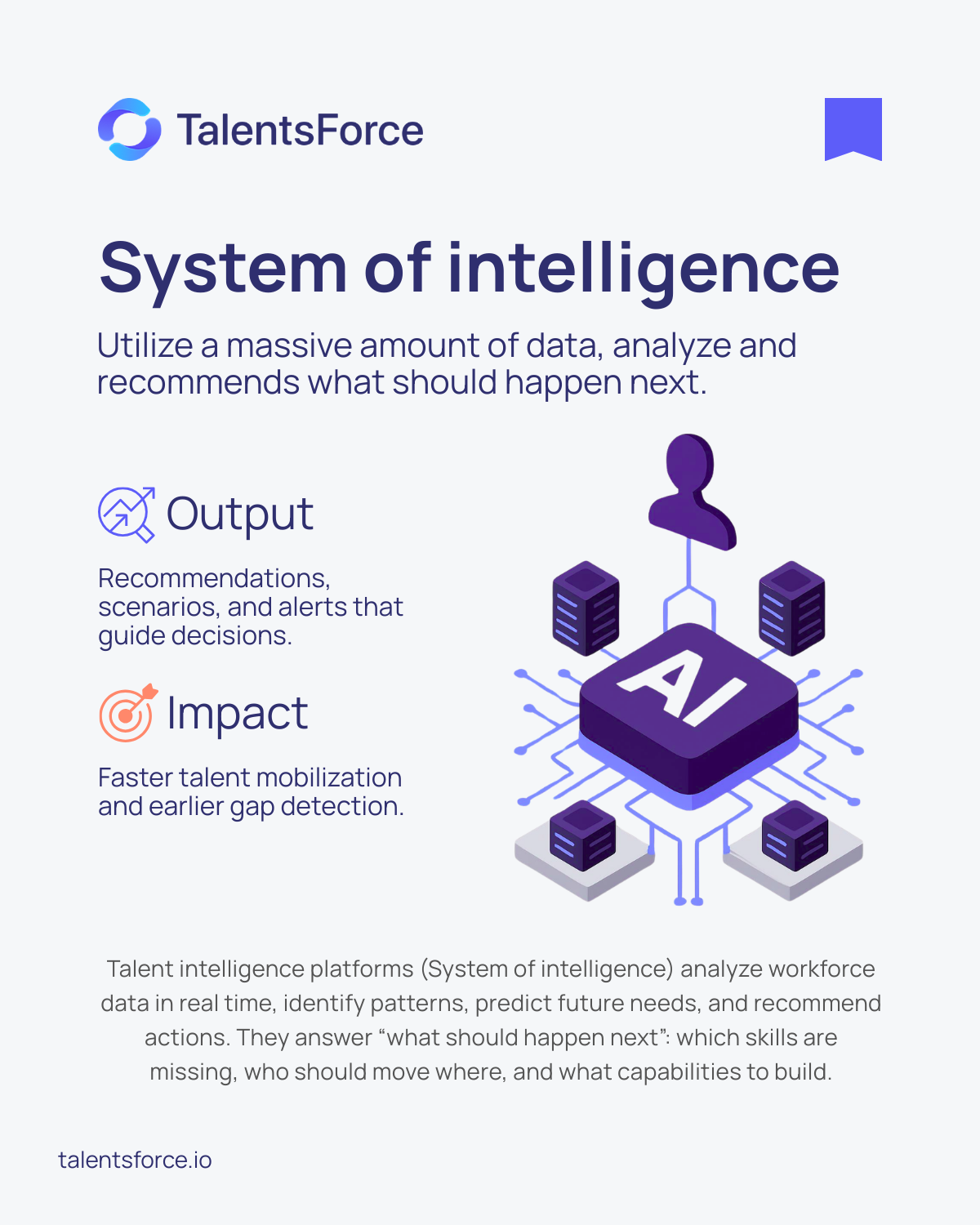
Talent intelligence sits above both. It uses skills data, drawn from job definitions, employee profiles, assessments, and learning systems, to answer capability questions: What does this workforce know how to do, what is missing, and what should we do because of that?
The three are complementary. Most enterprise organizations need all three. But only talent intelligence makes workforce capability visible as something the business can act on.
How TalentsForce is built on talent intelligence
The TalentsForce approach starts where talent intelligence starts: the skills foundation.
TalentsForce provides a skills inventory — a structured taxonomy of skills that standardizes how capability is defined across job postings, employee profiles, talent pools, and learning content. This creates the consistent layer that makes intelligence possible.
From that foundation, the platform supports the full decision loop:
Skills visibility — organizations can see capability distribution across roles, teams, and departments in real time, not just in quarterly reports.
Internal matching — employees can be surfaced as candidates for roles and projects based on skill fit, not title or tenure. The TalentsForce Agile Career Hub connects employees to internal opportunities before the organization goes to market.
Gap identification — the distance between current capability and required capability is made visible, for individuals and for the organization as a whole.
Career navigation — Career Navigator AI connects employees to internal paths aligned to their skills and goals, giving people a reason to grow inside rather than leave.
Workforce planning — skills supply and demand can be modeled against business strategy. Planning shifts from reactive — filling gaps after they appear — to anticipatory.
TalentsForce works as an intelligence layer across the systems an organization already uses. It does not replace HCM or ATS. It makes the data inside those systems usable for capability decisions.
Common questions
What is talent intelligence in simple terms? Talent intelligence is the ability to see what a workforce can actually do — not just who it employs. It structures skills data across roles, people, and systems so organizations can make better decisions about hiring, internal mobility, development, and workforce planning. It turns workforce data from a record into a decision-making input.
How is talent intelligence different from traditional HR data? Traditional HR data tracks transactions: who was hired, how long they stayed and what their performance score was. Talent intelligence tracks capability: what skills exist, where gaps are, which employees are ready for which roles. One looks back at what happened. The other looks forward to what is possible.
What does a talent intelligence platform actually do? It structures workforce skills data, makes it searchable and comparable, and connects it to decisions across hiring, mobility, development, and planning. In practice: match candidates to roles by skill fit, find internal talent before going to market, surface learning tied to specific gaps, and model workforce readiness against business needs.
Who needs talent intelligence most? Enterprise organizations with large, complex workforces where capability is distributed across many roles, teams, and systems — and where traditional methods of tracking talent have broken down. It is most critical for organizations under pressure to move fast: digital transformation, restructuring, rapid growth, or market shifts that demand new skills quickly.
Is talent intelligence the same as skills-based HR? They are related but not the same. Skills-based HR is an approach — structuring jobs, hiring, development, and mobility around skills rather than job titles. Talent intelligence is the data infrastructure that makes skills-based HR work at scale. Without talent intelligence, skills-based HR remains a strategy on paper. With it, it becomes operational.
How does TalentsForce support talent intelligence for enterprise HR? TalentsForce provides the skills foundation — a structured, standardized skills taxonomy — that makes talent intelligence functional. From that foundation, it delivers skills visibility, internal matching, gap identification, career navigation, and workforce planning support. It acts as an intelligence layer across existing HR systems, not a replacement for them.
How long does it take to implement talent intelligence? The most time-intensive step is building the skills foundation — standardizing and mapping skills across roles and people. The TalentsForce approach uses a pre-built database of over 70,000 skills and an AI-assisted taxonomy build, which significantly compresses what traditionally takes six months to a year. The first usable intelligence output is typically available within the first implementation phase.
If your organization is ready to build talent intelligence on a structured skills foundation, the TalentsForce platform starts there — and connects the intelligence to every talent decision that follows.