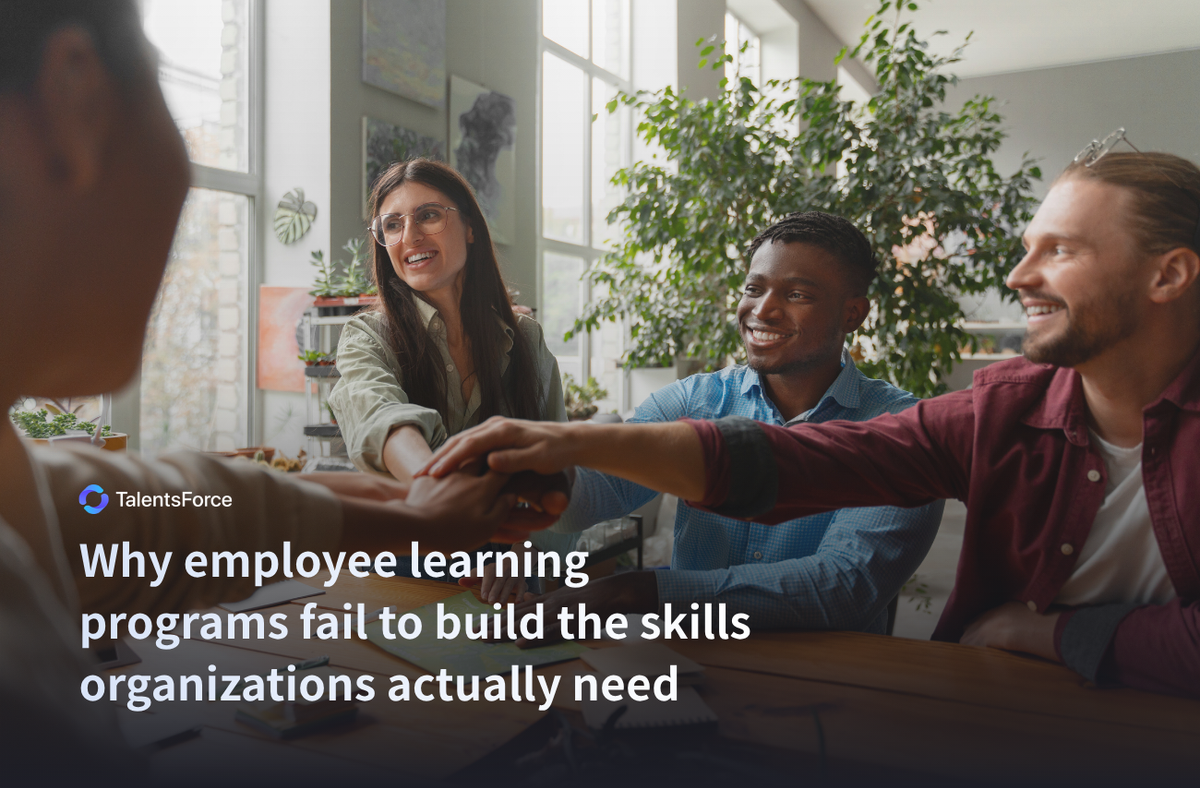
Why employee learning programs fail to build the skills organizations actually need
The training is done. The completion rates look good. The survey scores are fine.
And six months later, the same skills gaps are still there.
This pattern is familiar to most L&D leaders: Programs run, people attend, budgets are spent — and the capability problem the business was trying to solve has not moved.
It is rarely a motivation problem. Employees are generally willing to learn. It is rarely a delivery problem either. Online, in-person, cohort-based, self-paced format seldom explains the gap. The problem sits further back, before the program is even designed.
Most learning programs are built without a reliable view of what skills the organization actually needs to develop, and what skills employees actually have right now. That missing connection — between what is taught and what is genuinely needed — is where most of the value of enterprise learning disappears.
Why the gap between learning activity and capability change is so common
Building a learning program in a large organization involves many decisions made under significant uncertainty.
What skills are in short supply? Which roles are most at risk? What does each employee already know, and what do they need next? What learning content maps to those specific skill needs?
In most organizations, HR and L&D teams answer these questions with a mix of manager feedback, annual skills surveys, business partner conversations, and experience. The inputs are real, but they are slow, uneven, and not structured around skills at a consistent level of precision.
The result is programs shaped by what seems important rather than what is demonstrably missing. Training on leadership. Digital literacy. Communication. Broad topics that appear universally relevant — and are often genuinely useful — but that do not close specific skills gaps because they were not designed against specific gaps.
A program that covers everything tends to change nothing in particular.
The three reasons most programs miss
The need was defined too broadly. "We need more digital skills" or "the business wants stronger analytical capability" are not starting points for program design. They are descriptions of a direction. Building a curriculum from a direction rather than from a specific set of defined skill requirements produces content that is general enough to seem relevant but not specific enough to change anything.
The baseline was unknown. A learning program that does not start from where learners actually are will either teach what they already know or jump past what they are ready for. Most organizations do not have a consistent, structured view of what skills each employee currently holds at what level. Without that baseline, calibrating the content is guesswork.
There was no connection to what the business needed next. The strongest learning programs are built backward from a business need: This function needs to be able to do X in twelve months; that requires skills Y and Z; here is who has a gap in Y and Z; these are the people who need this program. Most programs are not built this way because the connection between business demand and learning content is not made systematically.
What a skills-grounded approach changes
When a learning program starts from a structured view of the skills the business actually needs — and the skills employees actually have — the design decisions change.
Content becomes specific. Instead of a general digital literacy track, the organization identifies that ten people in a specific function need to develop data analysis skills at a defined level because those skills are required for two roles the business is building. The program is smaller, more targeted, and more likely to produce the capability it was designed for.
Prioritization becomes clear. Every organization has more learning needs than budget or time to address them. When skills data makes both demand (what the business needs) and supply (what employees have) visible, the gaps that matter most for business performance are identifiable. Investment goes where it has the highest impact.
Progress becomes measurable. When a program is built against defined skill targets, the question "did it work?" has a concrete answer — not just a completion rate, but a capability change that can be tracked against the skill the program was designed to build.
How TalentsForce connects learning to what the business needs
The TalentsForce approach starts with a skills foundation — a structured and consistent map of the skills each role requires, compared to what each employee currently holds. This creates the baseline that most learning programs are built without.
From that foundation, TalentsForce identifies skills gaps — the difference between what each role requires and what each person currently has. These gaps are specific: Not "needs more digital skills" but a defined set of skills, at a defined level, in a defined role.
The Career in Motion pillar then connects those identified gaps to learning content. Development programs, courses, projects, and mentorships are recommended based on the specific skills each employee needs to close, rather than broad topics assigned to a cohort.
This means the learning investment lands where the gap actually is. Employees develop skills that connect directly to their career path. L&D teams can show which programs are closing which gaps — and which are not.
TalentsForce does not replace the learning content. It connects what is taught to what is needed, which is the step most enterprise learning programs are missing.
Common questions
Why do so many enterprise learning programs fail to improve actual skills? Most programs are designed without a precise view of the skills the business needs or the skills employees currently have. Without that starting point, content is built around broad topics rather than specific gaps, which means learning activity happens, but the capability the business needed does not get built.
What is the difference between a learning program and a skills-based learning program? A learning program delivers content to employees. A skills-based learning program starts from a specific skills gap — the difference between what a role requires and what an employee currently holds — and builds content designed to close that gap. The difference is in the starting point: One begins with content, the other begins with the need.
How do you know which skills gaps to prioritize for learning programs? By comparing two structured views: What skills each role and business function requires, and what skills the workforce currently holds. The largest and most business-critical gaps — those in roles most important to business performance — are the starting point for investment decisions.
Can better content fix the learning effectiveness problem? Content quality matters, but it is not the root problem. Even excellent content, if it addresses the wrong skills or is delivered to people who do not have the gaps it is designed to close, will not move capability in a meaningful way. The content problem and the alignment problem are different. Alignment is the more fundamental one.
How does TalentsForce support L&D teams? TalentsForce provides the skills foundation — a structured view of what skills exist and where the gaps are — that lets L&D teams design programs against real needs rather than perceived ones. It then connects identified gaps to specific learning recommendations, so employees receive development tied to what they actually need to grow in their career path.
Related reading
- What is talent intelligence and why it matters in enterprise HR
- How to identify skills gaps early — before they affect business performance
- Skills-based learning: what it is, how it differs, and why it works better
If the gap between learning investment and capability change is a problem your organization is trying to close, the TalentsForce approach starts with a structured view of what skills are actually needed.
→ See how TalentsForce works for enterprise HR