The question seems simple: How many job requisitions can one recruiter effectively handle? The Society for Human Resource Management (SHRM) suggests a median of 15 to 20 requisitions per recruiter. But this number tells only part of the story.
The honest answer depends on factors far more nuanced than a simple headcount. Role complexity, industry dynamics, available technology, and recruiter expertise all shape capacity.
More importantly, the type of hiring approach matters. Traditional credential-based recruiting demands different resources than skills-based talent acquisition.
Why requisition load matters for hiring quality
Recruiter bandwidth directly impacts the metrics that define hiring success. When recruiters manage too many requisitions simultaneously, the consequences cascade across the entire talent acquisition function.
- Time to hire increases. Overloaded recruiters struggle to move candidates efficiently through the pipeline. What should take days stretches into weeks.
- Quality of hire decreases. Without adequate time to thoroughly evaluate candidates, recruiters risk making suboptimal matches. Surface-level screening replaces deep capability assessment.
- Cost per hire escalates. Industry data shows the average cost per hire reaches approximately $4,700. When requisition loads exceed capacity, these costs climb higher. Extended hiring timelines and increased turnover from poor matches compound expenses.
- Team productivity suffers. Overload creates a cycle of reactive hiring. Recruiters spend time firefighting urgent needs rather than building sustainable talent pipelines.
The hidden cost of traditional hiring methods
Traditional recruiting approaches intensify these challenges. When recruiters rely on keyword matching and credential screening, they invest significant time reviewing resumes that may not reflect actual candidate capabilities. The rise of AI-optimized resumes makes differentiation even more difficult.
This is where skills-based hiring transforms the equation. By focusing on demonstrable capabilities rather than credentials alone, recruiters gain clearer visibility into candidate fit. The screening process becomes more efficient. Role requirements become more precise. Matching becomes more accurate.
Rethinking recruiter workload in a skills-based world
The question is not simply "how many requisitions can a recruiter handle?" The better question is "how do we enable recruiters to work more strategically?"
Organizations that adopt skills-based hiring supported by intelligent technology discover that their recruiters can manage higher requisition volumes without quality degradation.
The shift happens because the nature of the work changes. Less time is spent on manual screening and administrative tasks. More time goes to relationship building, strategic sourcing, and ensuring strong candidate-role fit.
Technology amplifies human judgment rather than replacing it. Recruiters remain essential to the hiring process. But their focus shifts from process management to strategic talent decisions.
How technology reshapes recruiter capacity
Modern talent intelligence platforms fundamentally change what recruiters can accomplish within their bandwidth. The right technology does not simply automate tasks. It amplifies strategic decision-making.
Intelligent automation handles routine work.
Candidate sourcing, resume parsing, and initial screening require less manual intervention. Recruiters reclaim time for high-value activities like candidate engagement and stakeholder collaboration.
Centralized data eliminates redundant effort.
When all candidate information, job requirements, and team feedback exist in one unified system, recruiters spend less time searching and more time evaluating.
Skills-based matching improves accuracy.
Instead of manually comparing credentials against job descriptions, recruiters leverage skills intelligence to identify candidates whose capabilities align with role requirements. This precision reduces time spent on unsuitable candidates.
Analytics reveal bottlenecks.
Real-time visibility into hiring metrics helps teams identify where processes slow down. Data-driven insights enable proactive adjustments rather than reactive problem-solving.
What TalentsForce enables
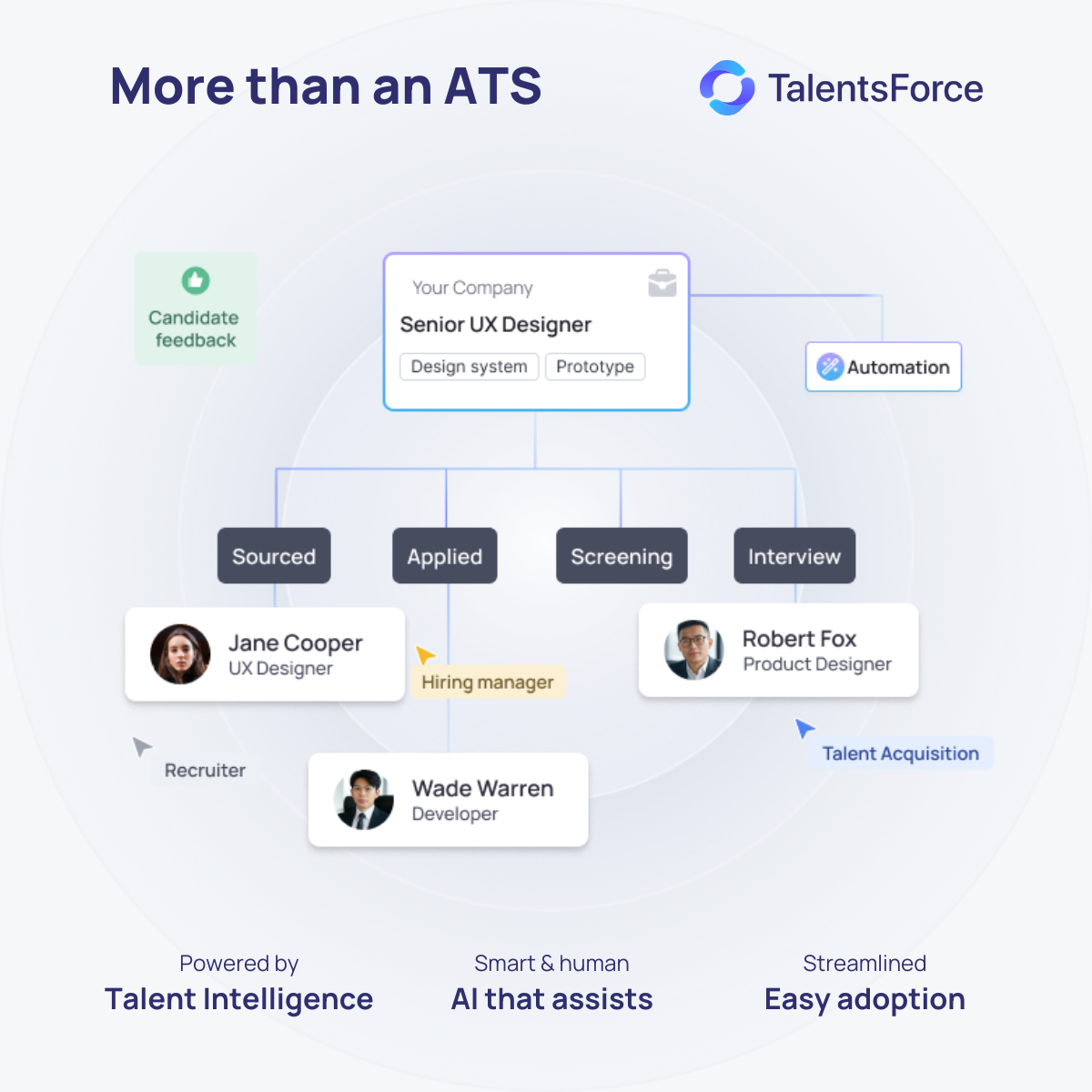
A talent intelligence platform built for skills-based hiring provides recruiters with tools that expand capacity without sacrificing quality:
- Skills inventory: creates organizational visibility into available capabilities, enabling internal mobility and reducing external recruiting needs
- Gen AI capabilities: accelerate job description creation, resume analysis, and candidate summarization
- Position management: ensures role requirements align with actual needed skills, improving match accuracy
- Universal search: eliminates time spent navigating between systems or searching for information
- Task management: keeps hiring activities organized and visible, reducing administrative burden
- Talent pools: enable proactive pipeline building, shortening time to fill when requisitions open
- Report and analytics dashboards: surface actionable insights that guide workload distribution and process improvements
Making the shift to sustainable hiring
Managing recruiter workload effectively requires both strategic thinking and the right enablement:
Regularly assess capacity based on role complexity. Not all requisitions demand equal effort. Senior leadership roles require different investment than high-volume technical positions. Distribute workload accordingly.
Invest in technology that creates efficiency gains. Manual processes consume time that could go to strategic activities. The right talent intelligence platform transforms how recruiters work.
Build talent pipelines proactively. Sustainable hiring means engaging candidates before requisitions open. Talent pools and skills-based matching enable this shift.
Measure what matters. Track not just requisition-to-recruiter ratios but quality of hire, time to productivity, and hiring manager satisfaction. These metrics reveal whether workload levels support organizational goals.