


In most enterprises, this is not a talent shortage problem. It is a visibility problem. Skills data sits across different systems, role requirements are not consistently defined, and internal candidates are judged through titles, history, or manager opinion instead of actual capability.
TalentsForce helps solve this by turning fragmented workforce data into usable talent intelligence. With a shared skills foundation, organizations can identify internal talent for critical roles, understand readiness more clearly, and guide development when a strong candidate is close but not yet fully ready.
The challenge
When a critical role opens, the pressure to fill it quickly is high. But internal matching often breaks down because the organization lacks a common way to compare people and roles.
A job title does not show capability. A performance review does not show role fit. A resume profile in one system does not connect cleanly with skills data in another.
As a result, internal talent stays hidden. External hiring becomes the default. Time is lost, cost rises, and the business misses the chance to move capable people into high-impact roles faster.
What TalentsForce makes possible
TalentsForce starts with a skills foundation. In this context, a skills foundation means a structured and consistent way to define, organize, and connect skills across roles, people, and talent systems.
Once that foundation is in place, internal matching becomes more reliable.
Organizations can see which employees already match the requirements of a critical role. They can also identify near-fit talent people who may not meet every requirement today, but have strong adjacency and realistic potential to move into the role with focused support.
TalentsForce then supports guided development. Guided development means showing the gap between a person’s current skills and the target role, then connecting that gap to practical next steps such as learning, projects, mentorship, or role pathways.
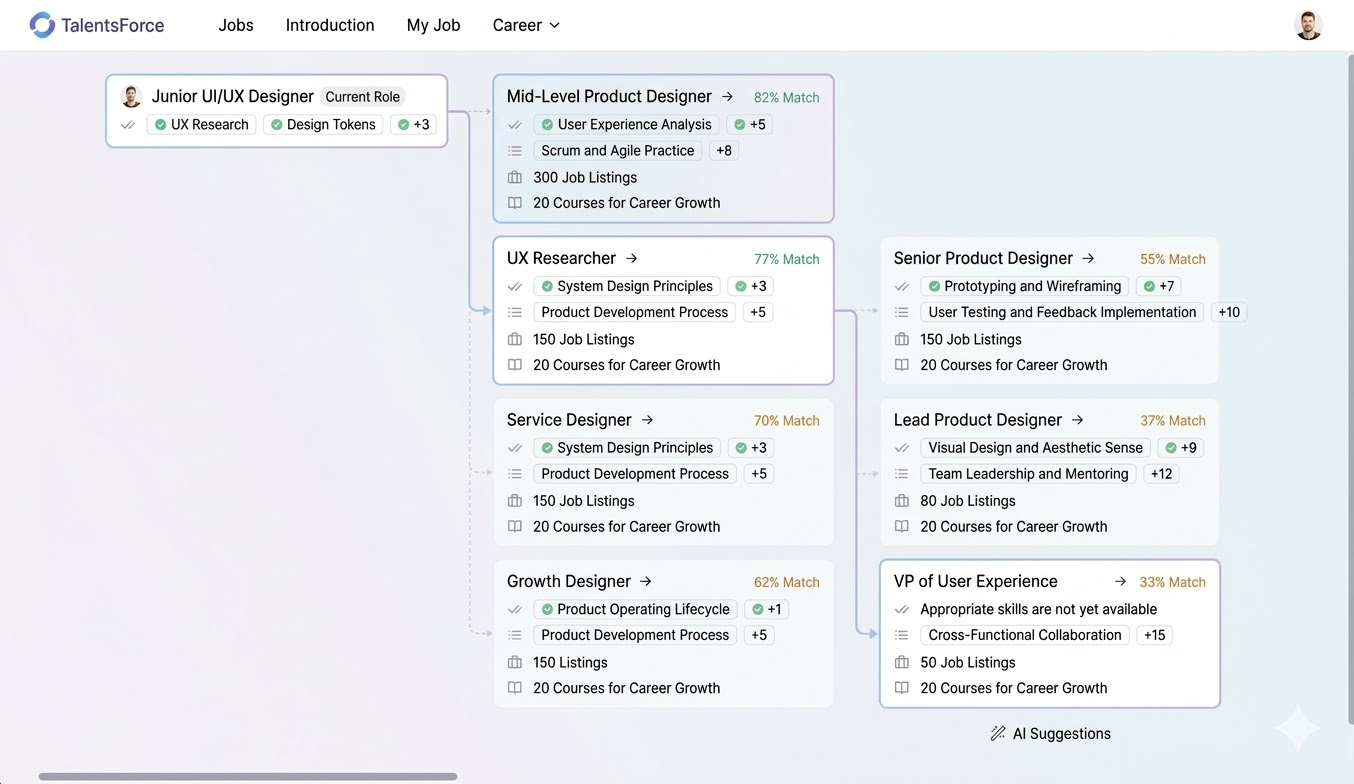
This gives the organization a more complete way to fill critical roles: Not only by finding the best available fit, but also by building readiness where the gap is small and the business case is strong.
Why this matters
This use case helps organizations reduce unnecessary dependence on external hiring for roles that could be filled from within.
It helps leaders make deployment decisions with more confidence because the decision is based on visible capability, not assumption.
It helps HR and business teams move faster because they can see both immediate matches and realistic internal pathways.
And it helps employees move forward with more clarity because career growth is tied to actual skills, real opportunities, and a clearer view of what comes next.
Business outcome
With TalentsForce, internal mobility becomes more than a policy. It becomes an operational way to fill critical roles faster, use workforce capability more effectively, and align development with real business demand.
That is the value of internal matching and guided development together. One helps the organization see who can move now. The other helps the organization act on who can be made ready next.


