

1. Recruiting teams are managing more work with fewer people.
2. We explore why workload is increasing, where the biggest efficiency opportunities exist, and how technology helps teams maintain hiring momentum without adding headcount.
Recruiting teams have 24 people on average now, down from 31 in 2022. Combined with the fact that 62% of HR departments are currently working beyond their typical capacity, an increase from 57% in 2023.[1]
The gap between work and capacity keeps widening. Most teams can't add headcount, so something about the process needs to change.
Why workload is increasing faster than team capacity
Several factors drive this imbalance. Hiring processes have become more complex, with teams conducting 42% more interviews per hire than three years ago.[2] AI-influenced resumes have made early screening more time-consuming, as recruiters now verify resume details and question the authenticity of candidate claims. Rising application volumes compound the problem, requiring careful validation at each step.
Where the process breaks down
Look closely at where recruiter time actually goes, and you'll see friction throughout the process.
Your candidate data lacks standardization. Some resumes live in your ATS, others in email, still more in spreadsheets. Finding previous applicants means searching three different ways. You end up re-screening people you've already talked to.
Six interviewers provide feedback through email, Teams, and verbal conversations. Consolidating everything takes days. One person doesn't respond, and the entire decision process stalls.
Phone screen insights never reach interviewers. You manually copy information between systems. Different people ask candidates the same questions because nobody knows what's already been covered.
These inefficiencies add weeks to time-to-hire. Each week is another opportunity for your best candidates to accept offers elsewhere.
What needs to change
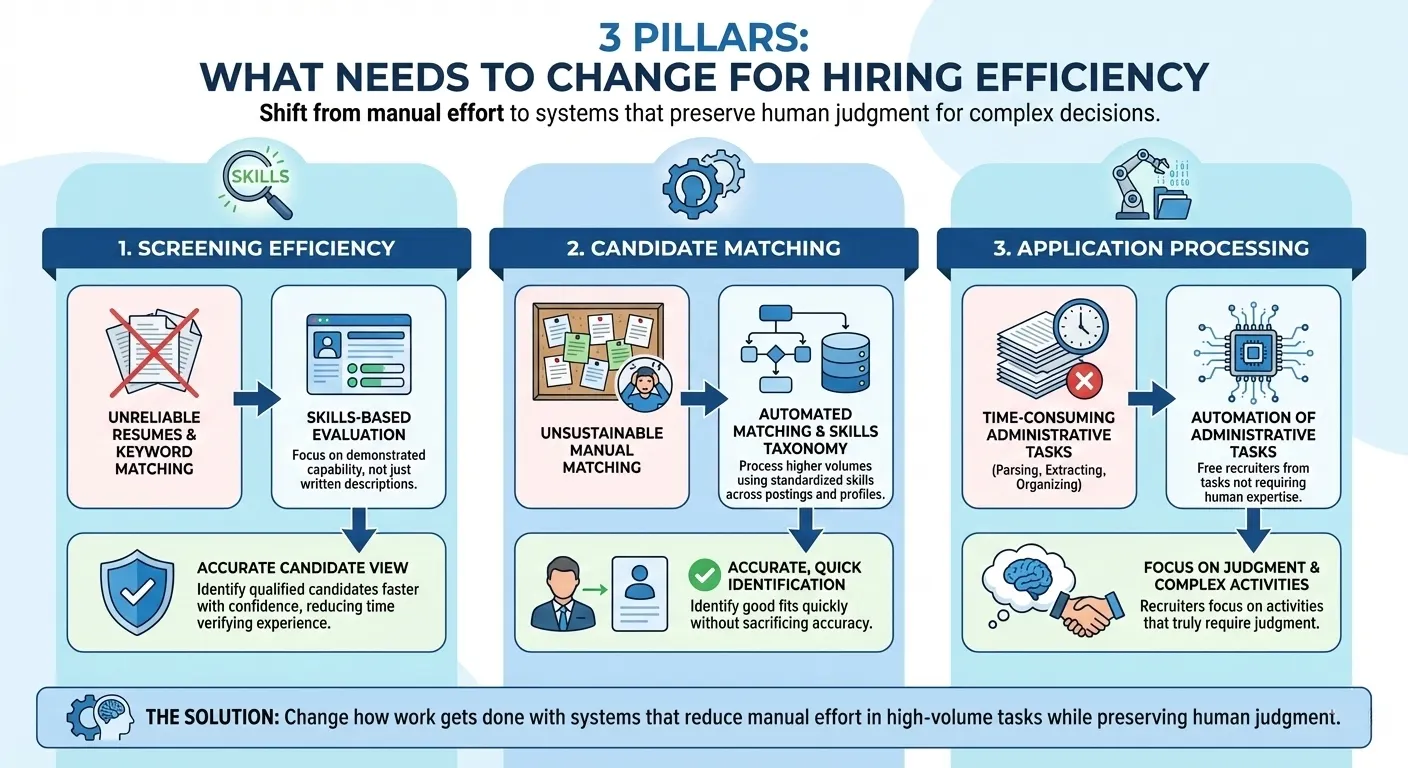
Working harder or faster won't solve this. The answer is removing the friction that makes hiring unnecessarily difficult. Three areas create the biggest opportunities:
Screening efficiency
Resumes are unreliable early signals. Skills-based evaluation shows candidate capability more accurately than resume formatting or keyword matching. Recruiters can identify qualified candidates faster by focusing on specific skills the role requires. Verifying fabricated experience takes less time when evaluation centers on demonstrated capability.
Candidate matching
Dozens of open positions and thousands of applications make manual matching unsustainable. Skills-based automation processes higher volumes without sacrificing accuracy. When job postings and candidate profiles use standardized skills language, identifying good fits becomes straightforward.
Application processing
Parsing resumes, extracting information, and organizing candidate data don't require human expertise. Freeing recruiters from these tasks means more time for evaluating culture fit, building candidate relationships, and advising hiring managers.
Each solution addresses a specific friction point: unreliable early signals, manual comparison work, and repetitive administrative tasks. Fix these, and recruiter time shifts from fighting the process to doing work that requires judgment.
How TalentsForce helps teams do more with existing capacity
TalentsForce addresses these friction points through automation and skills-based intelligence working as a unified system.
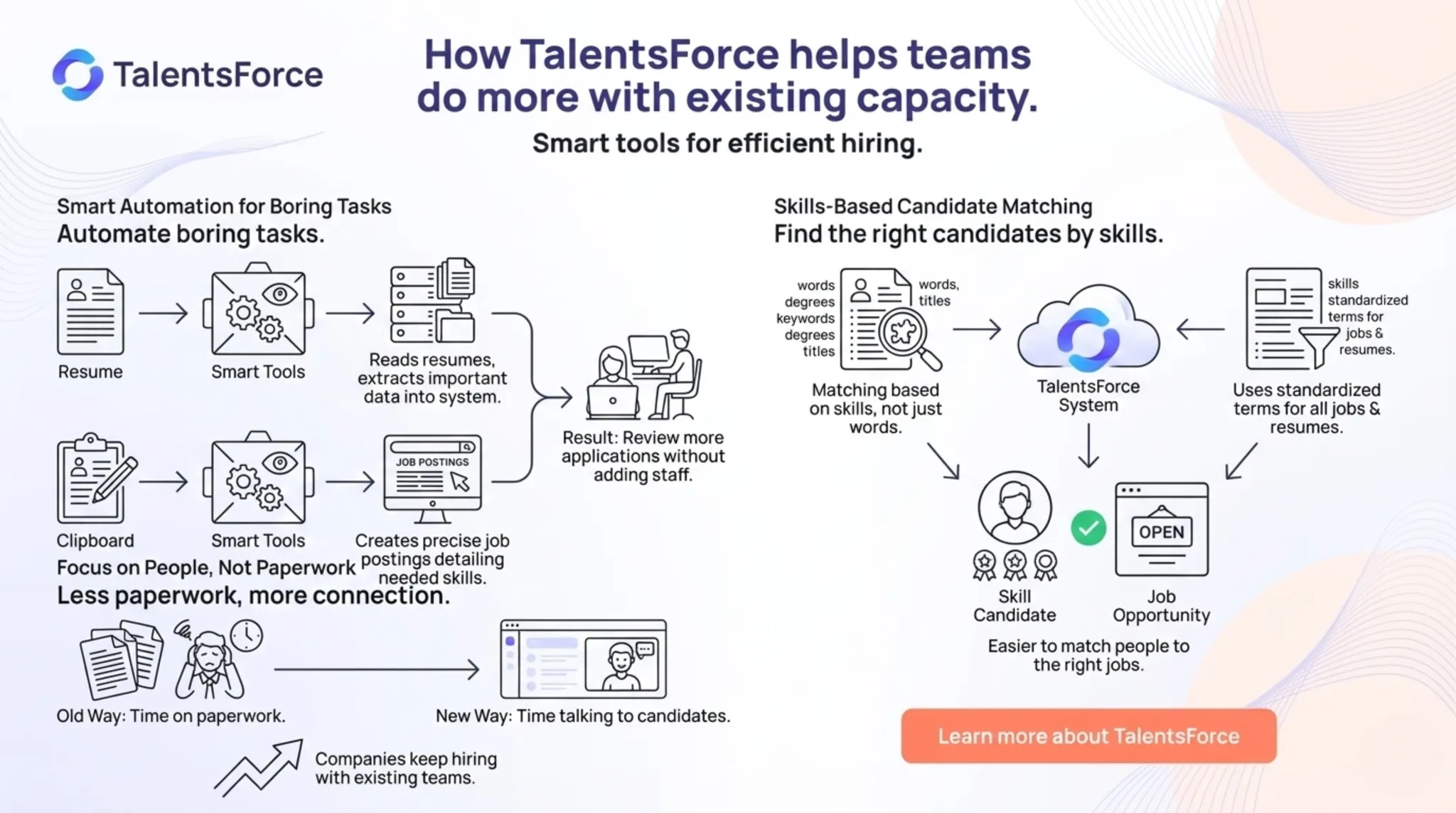
- Skills Inventory establishes a standardized taxonomy across your organization. Job postings and candidate profiles use the same language. This change eliminates the "searching three different ways" problem and makes candidate comparison straightforward.
- Gen AI tools build on this foundation by handling time-intensive administrative work. CV parsing extracts and standardizes candidate information automatically. Job description generation creates clear, skills-focused postings faster. Higher application volumes become manageable without increasing headcount.
- Matching candidates to roles shifts from keyword guessing to actual skills requirements. The system evaluates based on what the role needs, not what words appear in a resume. Evaluation becomes both faster and more accurate.
With these tools, recruiters spend less time on paperwork and more time talking to good candidates. This helps companies keep hiring even if they don't have more staff.
Building sustainable operations
Lean recruiting teams will continue. Organizations are choosing better processes and supporting technology over bigger headcounts.
Teams handling this successfully focus on three things:
- Standardize evaluation: Use consistent skills definitions and decision frameworks across roles. This eliminates time spent figuring out how to evaluate each position differently.
- Connect information: Keep candidate data, feedback, and decisions in systems that communicate. Phone screen notes appear when scheduling interviews. Interview feedback feeds into offer decisions without manual transfer. Bottlenecks become visible immediately.
- Automate repetitive work: Let technology handle scheduling, data entry, and status updates. Recruiter time goes to judgment calls and relationship building.
These three work together. Standardization enables automation. Automation frees time for relationship work. Connected systems make standardization effective across the workflow.
Building a process that works with you instead of against you makes doing more with less manageable.
Sources:
[2] SHRM. "State of the Workplace 2025."
[2] Ashby. "Recruiter Productivity | 2025 Talent Trends Report."


