

1. Internal mobility is a repeatable way to assemble the right capability fast, without waiting on external hiring cycles.
2. It improves execution speed, innovation throughput, and growth economics when skills are visible and opportunities are transparent.
3. Most programs stall because skills data exists but is fragmented and inconsistent across systems.
4. Standardized skills become the common language that makes mobility scalable and turns record data into execution decisions.
In relation to the workforce strategy for the business growth plan, one key thing you may find familiar is this: The right capabilities (for example, people with a specific skill set required to deliver the plan) cannot be assembled fast enough, even though the work is clear and the budget is approved. This is when external hiring is an option, but it is not a repeatable way to move at the speed of strategy.
Internal mobility is.
When an enterprise can see what people can do and match them to strategic opportunities.
Instead of going through a long, costly recruitment process, you ask, “Give me a list of internal candidates with international sales,” and a list of internal candidates with the exact skill you need, or who have completed a training course for those skills, shows up instantly.
You know the exact person with the right skills from within.
The ability to, one, identify the exact skills within your organization, two, let talent move quickly, and three, make internal opportunities transparent, makes internal mobility a lever for execution and innovation, not a “nice-to-have” HR program.
The growth mechanism is simple
Internal mobility turns workforce capacity into a dynamic resource. Instead of waiting for hiring cycles, you redeploy what you already have to the work that creates growth.
That changes three outcomes that leaders care about:
Execution speed
Teams form faster around priority initiatives because you can find relevant capability, not just available headcount.
Innovation throughput
New problems get new perspectives. People carry domain knowledge across silos. Ideas transfer with them.
Growth economics
You spend less to build capability, and you keep more of the people you already invested in.
Cost saving
Instead of costly agency fees or losing opportunities due to waiting for the new employees to familiarize themselves with your enterprise, and generate value. You spend less on hiring, training, and improving retention.
Innovation does not come from “movement” in general
Mobility creates innovation in different ways depending on the type of move.
Research on workforce mobility points to two patterns with distinct trajectories over time:
- Problem switching, where employees move into a new functional domain, tends to produce peak innovation in the medium term. The first phase is learning. The next phase is where the “fresh eye” effect shows up: People understand enough to contribute, but they still question assumptions that a team has normalized.
- Site switching, where employees move locations within the same domain, tends to deliver high immediate value and then meaningful long-term innovation gains. The person is productive quickly because the domain is familiar, and the longer horizon benefit comes from combining local context with existing expertise.
This matters because internal mobility is often managed as a single program with a single metric. In practice, mobility is a portfolio. Different move types produce different kinds of value on different timelines.
The financial case is already strong
Internal mobility is a cost-saving engine for growth.
Hiring from the outside can cost up to six times more than building capabilities from within. Even when the salary is similar, the hidden costs are not: Search time, onboarding, delayed productivity, cultural assimilation, and the opportunity cost of roles left unfilled.
Mobility also improves retention in a measurable way. Internal movers are reported to be 66% to 72% more likely to remain at the organization the following year. That is not a soft benefit. It is reduced backfill, reduced knowledge loss, and higher ROI on development spend.
There is also a clear risk signal in the market. 77% of organizations report losing talent due to a perceived lack of internal career development opportunities. People do not only leave for compensation. They leave when they cannot see a path.
Why most internal mobility programs stall
Internal mobility fails less because of intent and more because of visibility.
Many enterprises do not lack talent. They lack a reliable way to see capability across the organization and match it to work.
Skills exist everywhere, but they do not connect:
- Job descriptions describe requirements, but often in inconsistent language across functions.
- CVs and profiles list experience, but they are unstructured and hard to compare.
- HRIS stores roles and history, but not always the actual skills used in the role.
- LMS shows learning activity, but not always verified capability or proficiency.
- Performance notes capture real signals, but they are not standardized or searchable.
Even when the organization “has skills data,” it is fragmented across systems that were never designed to speak the same language. The result is predictable: internal opportunities are filled through networks and manager familiarity rather than capability fit. Employees cannot discover roles that match their adjacency skills. Leaders cannot staff strategic initiatives without long negotiation cycles.
Internal mobility becomes slow, biased, and hard to repeat.
Skills as a common language is the unlock
Internal mobility works when skills become a shared language across the enterprise. Not as “tags” on profiles, but as a consistent layer that connects strategy, work, and people.
That is the role of the TalentsForce Talent Intelligence Platform.
TalentsForce starts with a Skills Foundation: a centralized skills taxonomy and Skill Inventory that consolidates skill signals from the places they already exist (job descriptions, CVs, profiles, HRIS, performance data) and standardizes them into one vocabulary. With that foundation in place, skills become a translation layer between business demand and workforce supply.
Demand becomes clear because roles, projects, and strategic initiatives can be expressed in skills, consistently across functions. Supply becomes searchable because capability is mapped into the same skill terms across the workforce. Matching becomes scalable because the definitions don’t change by team, site, or business unit.
This is the difference between a system of record and a system of intelligence.
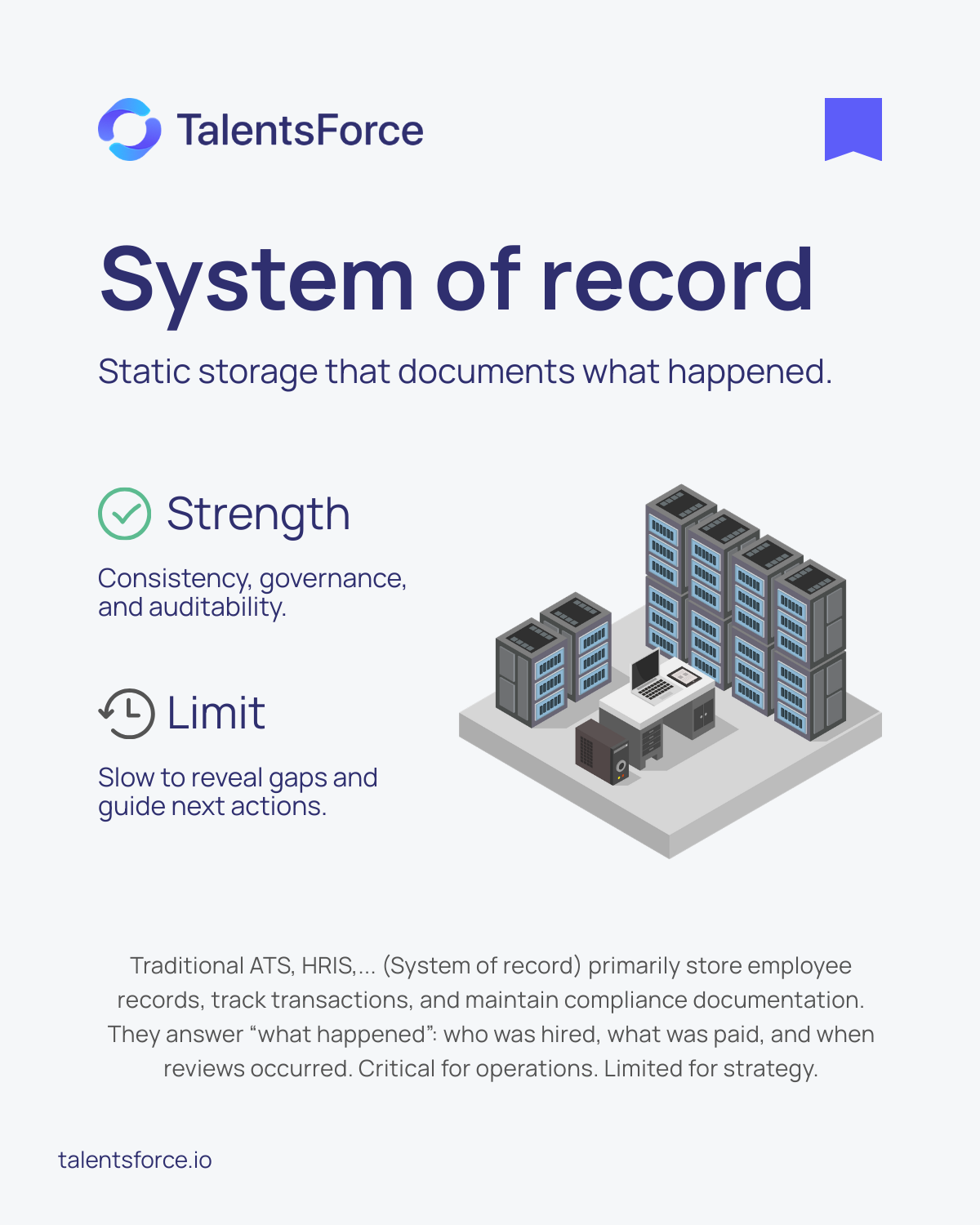
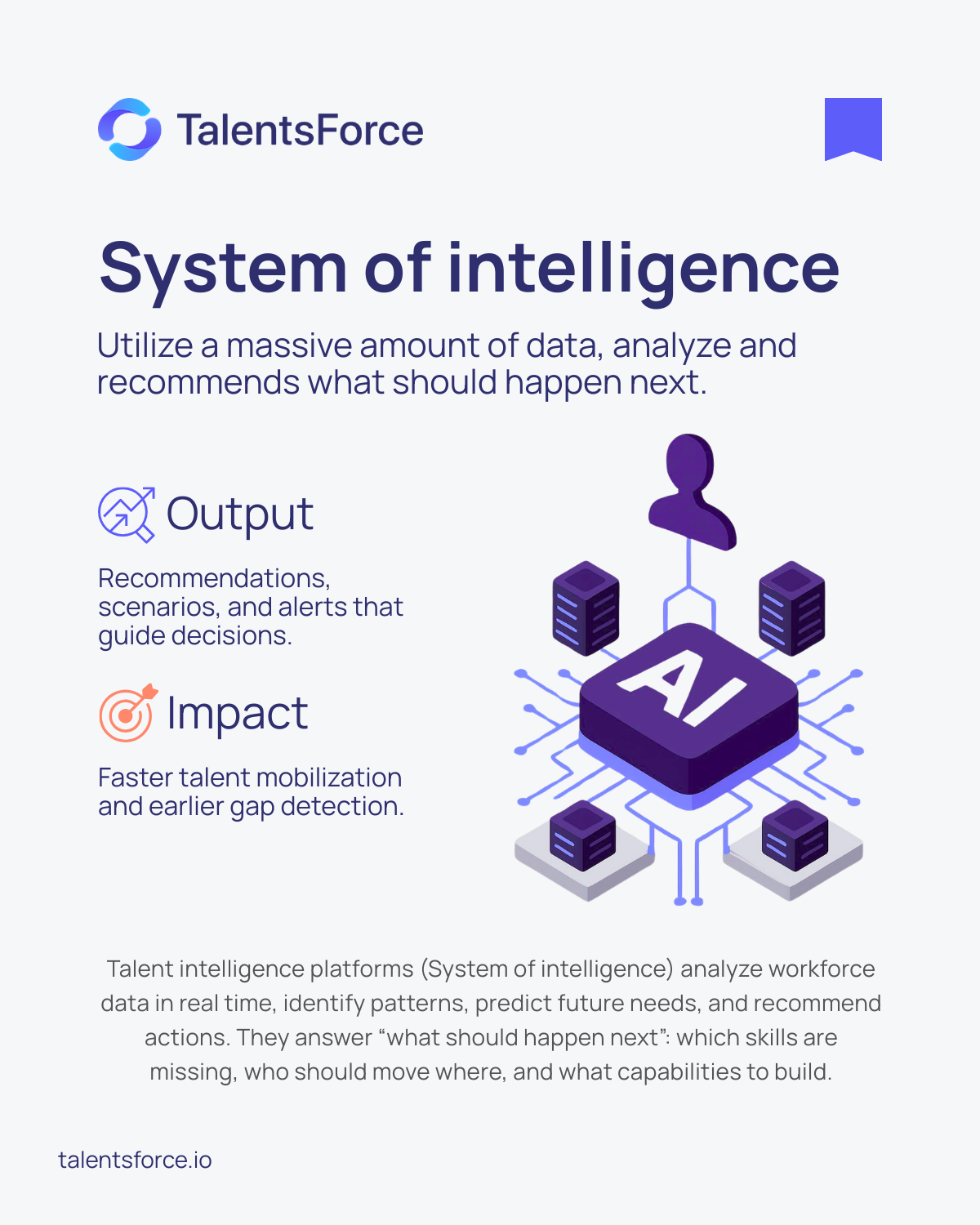
A system of record tells you where someone sits, what their title is, and what training they took.
TalentsForce helps you operationalize skills data so leaders can answer execution-level questions with confidence:
- Who can take this initiative now, without breaking other priorities?
- Where do we have capability concentration risk across teams or locations?
- Which skills are emerging internally, and which are missing for the next growth plan?
- Which internal moves will create the innovation trajectory we need over the next 6–12 months?
When skills become usable in this way, internal mobility stops being a program. It becomes a repeatable growth capability.
Why 2030 changes the urgency
Looking toward 2030, internal mobility is predicted to become a primary growth channel because the operating reality is changing.
Business decisions already move faster than workforce decisions. That gap is becoming expensive. Strategy cycles are shorter. Markets pivot quickly. AI is changing job content faster than job titles. Enterprises will need workforce decisions that can keep up.
High-performing organizations are already using internal talent marketplaces to redeploy talent quickly during uncertainty. The advantage is not a tool. The advantage is agility: the ability to move resources toward growth areas without waiting for external recruitment.
For the emerging workforce, internal mobility is also becoming non-negotiable. Roughly 61% of Gen Z workers cite career growth opportunities as a top priority when choosing and staying with an employer. If internal paths are unclear, attrition becomes a structural tax.
The point
Internal mobility is no longer mainly about career development. It is about organizational capacity to execute and innovate on demand.
By 2030, the companies that treat internal mobility as a primary growth channel will not simply retain more people. They will ship strategy faster, learn faster, and build capabilities at a lower cost.
Start by making skills visible and consistent. From there, mobility becomes a system you can scale.


