


1. Skills are fragmented across systems, so enterprises can’t see true capability.
2. This drives “competency blindness”: slow hiring, slow mobility, reactive planning.
3. The fix is to standardize skills (inventory + taxonomy) and consolidate skill signals.
4. Once skills become the common language, decisions improve in hiring, mobility, and planning
Many enterprises look at their dashboards and conclude they are "short of people." But the problem often lies elsewhere; businesses are not seeing the true capabilities of their workforce because skills are fragmented across different "recording" systems, and there is no common language for retrieval, comparison, and decision-making.
Signs of "Competency Blindness" in Enterprises
You will see these familiar symptoms appearing simultaneously:
Positions remain open for a long time, but there are still suitable candidates internally.
This isn't because there aren't enough people. It's because there's no way to "find people based on skills" at the enterprise scale. When searching based solely on current job titles or units, you'll miss profiles with similar skills but in different teams or positions.
Internal mobility is slow, even though everyone agrees it's necessary.
Rotation proposals often rely on the manager's and HRBP's network. When scaling to thousands of employees, this approach becomes unscalable.
Workforce planning sees headcount and job titles, but not capability.
In workforce meetings, the crucial question isn't "how many people are needed," but "what skills are missing, where, and for how long?" Without seeing capability, planning will always be reactive.
These aren't isolated operational issues. There are issues of "visibility" regarding skills.
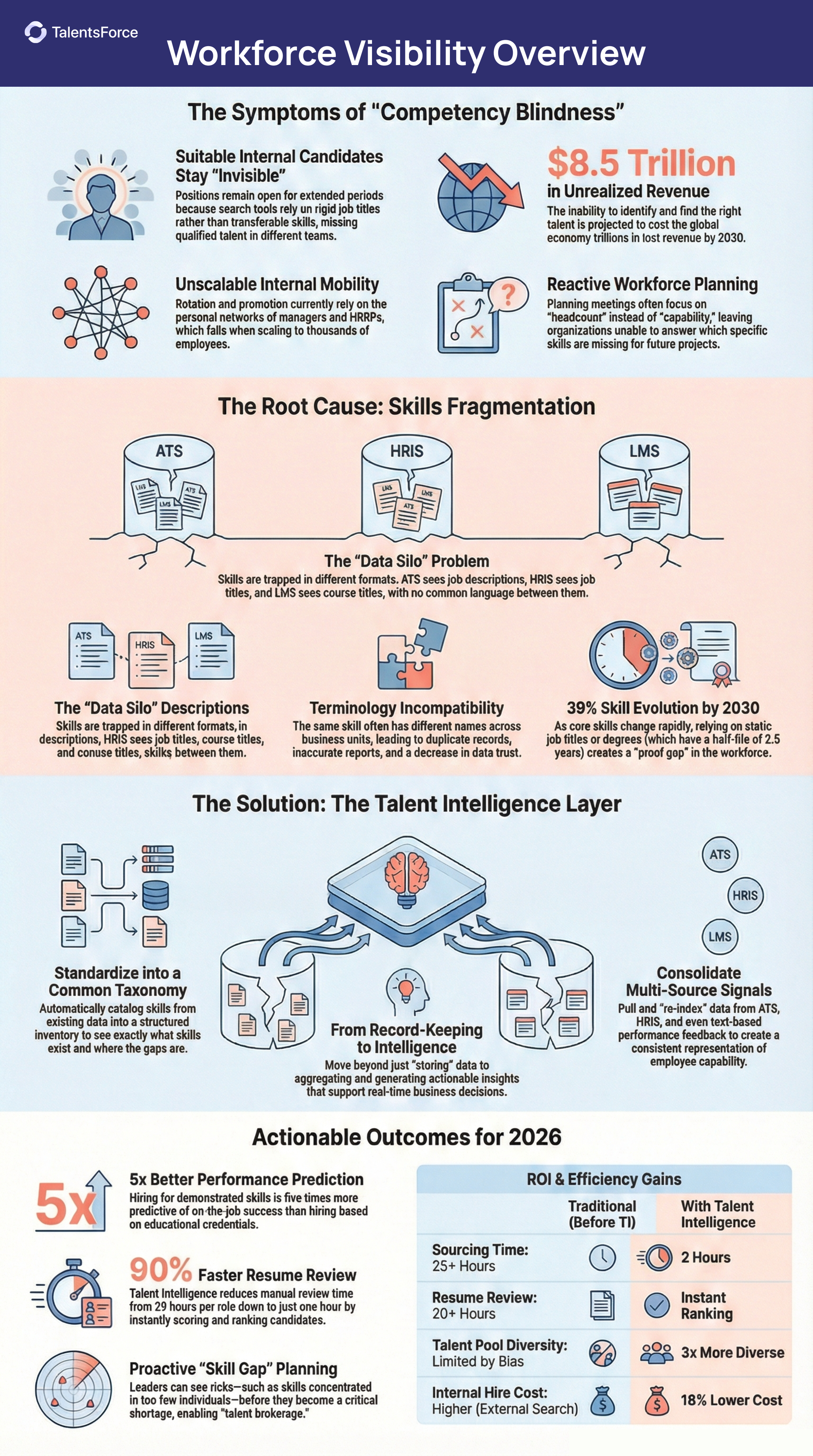
The root cause is skills fragmentation across record systems
Enterprises don't lack data. They lack a layer of intelligence to unify and standardize.
In reality, skills are scattered across many places:
- ATS views skills based on job descriptions and CVs
- HRIS/HCM views them based on job titles and organizational structure
- LMS views them based on courses and certifications
- Performance notes, projects, feedback… contain skill signals in "text" form
The most common problem is duplication and incompatibility: the same skill has many different names, or the same name has different meanings across business units. The result is incorrect searches, inaccurate reports, and a gradual decrease in trust in the data with each "reconcile" cycle.
This is why the Talent Intelligence Platform is designed as an intelligence layer: not just storing, but aggregating, analyzing, and generating actionable insights from multiple internal data sources and (when needed) market data.
Moving from Record to Intelligence by Re-indexing the Workforce by Skills
To see hidden talent, enterprises need to do one crucial thing: standardize skills into a common platform, and then use it to consolidate skill signals from all sources.
Creating a Standardized Skill Inventory and Taxonomy
A skill inventory isn't a list of skills to "tick." It's a structured data layer that helps you answer:
- Which skills exist in the workforce?
- Who possesses those skills, and at what level (based on existing signals)?
- Which skills are lacking according to the business direction?
TalentsForce builds Skill Inventory as a foundational competency, automatically cataloging skills from existing data and standardizing them according to taxonomy.
Consolidating Skill Signals for a Consistent View
A "single source of truth" for skills doesn't come from forcing all teams to use the same form. It comes from:
- Pulling data from existing systems (ATS, HRIS/HCM, LMS, text sources)
- Standardizing skill terminology (mapping, synonyms, taxonomy)
- Eliminating duplication and unifying definitions according to governance
This is also how a Talent Intelligence Platform creates value: merging multi-source data and bringing it to a unified skill representation layer for stable analytics and matching.
When skills become a "common language," data begins to generate reliable intelligence to change decisions.
Intelligence → Action: 3 Decision Changes Immediately When You See Talent
Enterprises don't buy another dashboard. Enterprises need improved decisions right in the workflow.
Hiring Faster and More Accurately When Matching by Skills, Not by Title
When requirements are standardized by skills, shortlists change by quality, not just by quantity. Recruiters and hiring managers can see fit based on capability, reducing the "re-explain job description" cycle and shortening decision-making time.
At the platform level, TalentsForce defines value as connecting skills visibility with hiring, mobility, and planning decisions.
More effective movement because internal talent becomes "findable"
There are always people with transferable skills within the company, but previously they were hidden behind job titles, teams, or role history. When you have a consistent skill inventory and view, internal mobility is no longer dependent on luck and relationships. It becomes a data-driven option.
Proactive planning, because it sees skill gaps, not waiting for a "shortage" to react
Workforce planning often fails not because of a lack of reports, but because of reports containing the wrong type of data. When you look at headcount, you only see numbers. When you look at skills, you see risks and opportunities:
- Which skills are too concentrated in a few individuals?
- Which skills are declining as the project changes?
- The gap between strategic competency needs and current capabilities?
This is how the shift from "reactive analysis" to "proactive management" is set as the outcome for the 2026 marketing plan for enterprises: record → skills foundation → intelligence → action.
Conclusion
Enterprises usually don't lack talent. Enterprises lack the ability to see talent consistently, on a large scale, and reliably enough to change decisions.
When skills are fragmented across different record systems, true capabilities remain obscured. Only when skills are standardized into a common platform can intelligence drive action in hiring, mobility, and planning.


