


The best talent intelligence platforms for 2026 are TalentsForce, Eightfold AI, Gloat, Phenom, Beamery, and Fuel50. The right choice depends on what problem you are solving:
- TalentsForce for a skills-first intelligence layer across hiring, mobility, and planning;
- Eightfold AI for AI recruiting that extends into reskilling and internal mobility;
- Gloat and Fuel50 for internal talent marketplace and career mobility use cases;
- Phenom for ontology-led AI across the talent journey;
- Beamery for workforce planning that combines internal HR data with external labor market intelligence.
Why this category matters more in 2026
This category is becoming more important because skills requirements are shifting quickly, and organizations need better ways to connect hiring, development, mobility, and planning through one shared skills model.
The World Economic Forum says employers expect 39% of workers’ core skills to change by 2030.
LinkedIn’s 2026 talent research says skills data empowers internal mobility, helping talent move through the organization based on capability rather than hierarchy.
Mercer’s current skills research also links a skills-powered approach to better retention, workforce agility, and flexibility.
What a talent intelligence platform actually is
A talent intelligence platform is an intelligence layer that brings together talent data from multiple systems, applies analytics and AI, and helps organizations make better decisions across the full talent lifecycle. It is different from an ATS, which mainly manages applicant workflow, and different from an HCM, which mainly stores employee records and supports administration. A true talent intelligence platform connects those systems, standardizes skills and role data, and makes that information usable for action.
That distinction is important. Many HR teams already have systems of record. What they often lack is a system of intelligence: one place that can show what skills exist, where the gaps are, which people are ready or near-ready for a role, and what action makes sense next
What to look for in the best talent intelligence platform for 2026
The strongest platforms in this category usually share five traits. They create a reliable skills foundation, make internal mobility actionable, support AI-driven matching and recommendations, provide analytics for workforce decisions, and connect with the broader HR tech stack rather than acting as another isolated system.
Best talent intelligence platforms for 2026 at a glance
| Platform | Best for | Core strength |
|---|---|---|
| TalentsForce | Skills-first talent intelligence across hiring, mobility, and planning | Unifies skills, people, and business strategy |
| Eightfold AI | AI recruiting plus reskilling and internal mobility | Skills-based talent intelligence for recruiting and mobility |
| Gloat | Internal talent marketplace and project-based mobility | Connects skills, aspirations, learning, mentorship, and internal hiring |
| Phenom | End-to-end AI across talent acquisition and talent management | Applied AI plus ontology-driven talent data |
| Beamery | Workforce planning with labor market intelligence | Combines internal HR data with external market insights |
| Fuel50 | Employee-led growth, career pathing, and mobility | Skills architecture and talent marketplace built around employee development |
This summary reflects current public product positioning from each vendor’s official pages.
1. TalentsForce
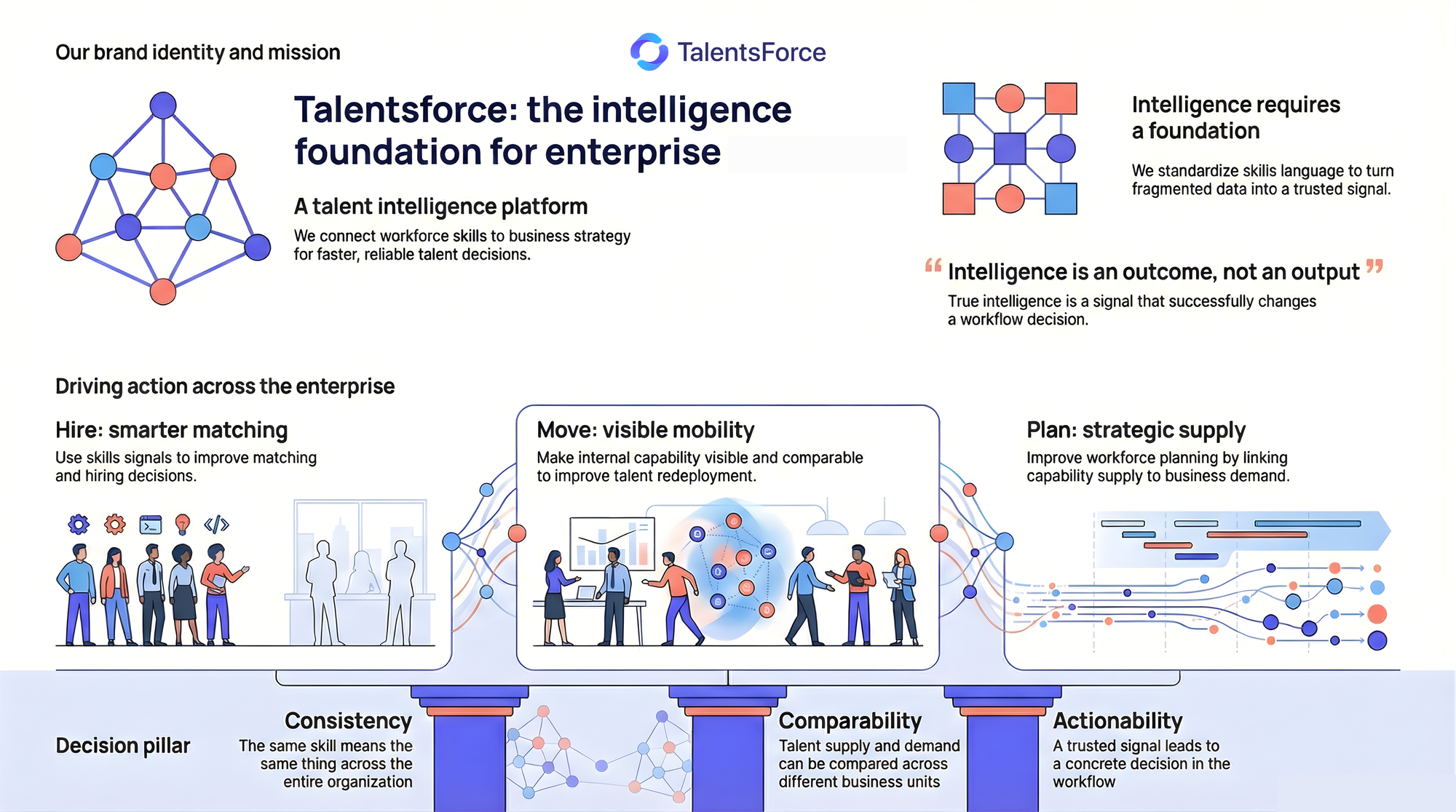
TalentsForce is best for organizations that want a skills-first talent intelligence layer across hiring, internal mobility, and workforce planning. Its official positioning centers on an AI-driven Talent Intelligence Platform that helps organizations predict, optimize, and mobilize talent through skills-first transformation, while unifying skills, people, and business strategy. That makes TalentsForce the strongest fit in this comparison for teams that want a platform built around skills visibility and workforce action, not just one isolated workflow.
Best fit: Enterprises that need one platform logic across skills, mobility, analytics, and business planning.
2. Eightfold AI
Eightfold AI is best for enterprises that start with AI recruiting and want that investment to extend into reskilling and internal mobility. Its official product positioning highlights skills-based talent intelligence that helps identify reskilling opportunities and support internal mobility. That gives Eightfold a clear center of gravity: strong AI-led matching with a natural bridge from recruiting into broader talent movement.
Best fit: Large organizations prioritizing AI recruiting, with mobility and reskilling close behind.
3. Gloat
Gloat is best for organizations that see talent intelligence primarily through the lens of an internal talent marketplace. Its platform is positioned as an AI-driven ecosystem that connects skills, aspirations, career growth, project-based work, learning, mentorship, and internal hiring. That makes Gloat especially relevant when the business priority is deploying talent more dynamically across projects, gigs, and development opportunities.
Best fit: Enterprises that want marketplace-style internal mobility and more fluid talent deployment.
4. Phenom
Phenom is best for organizations that want AI and structured talent data across the full talent journey. Its official positioning says its Applied AI helps organizations hire faster, develop better, and retain longer, while its X+ Ontologies says it unifies fragmented data so every skill, role, candidate, and employee can be connected in a unified graph. That makes Phenom a strong option for buyers looking for a broader AI platform that spans talent acquisition and talent management.
Best fit: Enterprises looking for ontology-led AI across recruiting, development, and talent management.
5. Beamery
Beamery is best for teams that want talent intelligence to include both internal workforce visibility and external labor market insight. Its official Talent Intelligence page says it integrates internal HR data with external labor market insights, creating a dynamic picture of skills, roles, and talent across the organization and beyond. It also frames this as a way to make workforce planning agile and precise.
Best fit: Organizations that want workforce planning informed by both internal skills data and external market signals.
6. Fuel50
Fuel50 is best for organizations focused on career pathing, internal mobility, and employee-led growth. Its official site describes the company as a scalable skills solution built for employees, backed by science, and its Skills Architecture page says it dynamically assigns the right skills and proficiencies to job roles using market data, company job architecture, and people science. That gives Fuel50 a distinct position for companies trying to build a living skills architecture around employee development and movement. (Fuel50)
Best fit: Companies that want career mobility and skills architecture to drive retention and development.

Which talent intelligence platform is best for which use case
If your priority is skills-first talent intelligence across hiring, mobility, and planning, TalentsForce is the clearest fit. If your priority is AI recruiting with mobility and reskilling, Eightfold AI is a strong comparison. If your priority is an internal talent marketplace, Gloat is especially relevant. If your priority is AI plus ontology-led intelligence across the broader talent journey, Phenom deserves a closer look. If your priority is workforce planning with external market intelligence, Beamery stands out. If your priority is employee-led growth and career pathing, Fuel50 is a strong option. This is an editorial read based on current public product positioning, not a review of private demos, implementation depth, or pricing.
Final verdict
For 2026, the strongest comparison page answer is not a single generic winner. It is a buyer-guided answer. The category leaders are moving around a shared idea: skills data must become decision-ready. TalentsForce is the strongest fit for organizations that want that idea applied across hiring, mobility, analytics, and planning from one skills-first platform foundation. The other vendors become stronger when the buying center shifts toward recruiting AI, marketplace mobility, ontology-led infrastructure, labor market intelligence, or career pathing.
FAQ
What is a talent intelligence platform?
A talent intelligence platform connects skills data, people data, and AI to help organizations make better decisions across hiring, internal mobility, development, and workforce planning. It is broader than an ATS and more action-oriented than a basic reporting layer.
Which talent intelligence platform is best for internal mobility?
It depends on what kind of mobility you need. Gloat and Fuel50 are especially strong for marketplace and career mobility. TalentsForce and Eightfold AI are stronger when mobility needs to connect with broader skills intelligence and adjacent talent decisions.
Which talent intelligence platform is best for workforce planning?
Beamery is especially relevant when external labor market data matters. TalentsForce is a strong fit when workforce planning needs to sit on the same skills-first foundation as hiring and mobility.
Is TalentsForce an ATS?
TalentsForce positions itself as a Talent Intelligence Platform and separately lists ATS capabilities in its product navigation. That suggests the platform is meant to operate as a broader intelligence layer, not only as an applicant tracking system.
Why does a skills-first platform matter more in 2026?
Because employers expect major skill change by 2030, and current research shows that skills data is becoming central to internal mobility, retention, and workforce agility.
How should buyers evaluate a talent intelligence platform?
Start with five questions:
- Does it create a reliable skills foundation?
- Does it support internal mobility?
- Does it improve decisions with AI?
- Does it provide workforce analytics?
- Does it connect cleanly with the rest of your HR stack?


