

The recruitment landscape in 2026 demands more than basic resume storage and candidate tracking. Organizations now require intelligent platforms that connect workforce skills to business strategy while streamlining hiring workflows. Modern applicant tracking systems combine AI-powered automation with strategic talent intelligence to help businesses attract, evaluate, and mobilize talent faster than ever.
With 98% of Fortune 500 companies using ATS platforms and organizations seeing up to 30% reduction in time-to-hire through effective implementation, choosing the right system has become critical for competitive talent acquisition. This comprehensive guide examines the top applicant tracking systems for 2026, evaluating their capabilities across AI features, skills intelligence, integration ecosystems, and business impact.
What makes an exceptional ATS in 2026
Before examining specific platforms, understanding the defining characteristics of modern applicant tracking systems helps clarify what separates basic tools from strategic talent acquisition platforms. The best systems in 2026 share these essential capabilities:
AI-powered candidate intelligence - Advanced resume parsing and matching that goes beyond keyword scanning to understand skills, experience, and potential fit. Generative AI tools for creating job descriptions, summarizing candidate profiles, and generating interview questions reduce manual work while improving quality.
Skills-based hiring architecture - Skills frameworks that focus on competencies rather than traditional qualifications widen talent pools and improve both attraction and retention. Research shows 81% of employers now use skills-based hiring, up from 56% in 2022, making this capability essential rather than optional.
Predictive analytics and workforce planning - Systems that analyze historical hiring data to forecast which candidates will succeed long-term and identify future talent needs before vacancies arise enable proactive rather than reactive recruitment.
Comprehensive integration capabilities - Seamless connections with job boards, HR tools, calendar systems, video interviewing platforms, and learning management systems create unified workflows without manual data transfer.
Mobile-first candidate experience - With over 60% of job seekers applying via mobile devices, responsive application processes, branded career pages, and mobile-optimized communication maintain engagement throughout the hiring journey.
Diversity and bias reduction tools - Anonymized resume screening, gender-neutral job description analysis, and diversity reporting dashboards help organizations build more equitable hiring processes while meeting compliance requirements.
The top applicant tracking systems for 2026
1/ TalentsForce: The talent intelligence platform for skills-driven organizations
Best for: Businesses seeking unified talent intelligence that connects external hiring with internal mobility and workforce planning.
Company overview
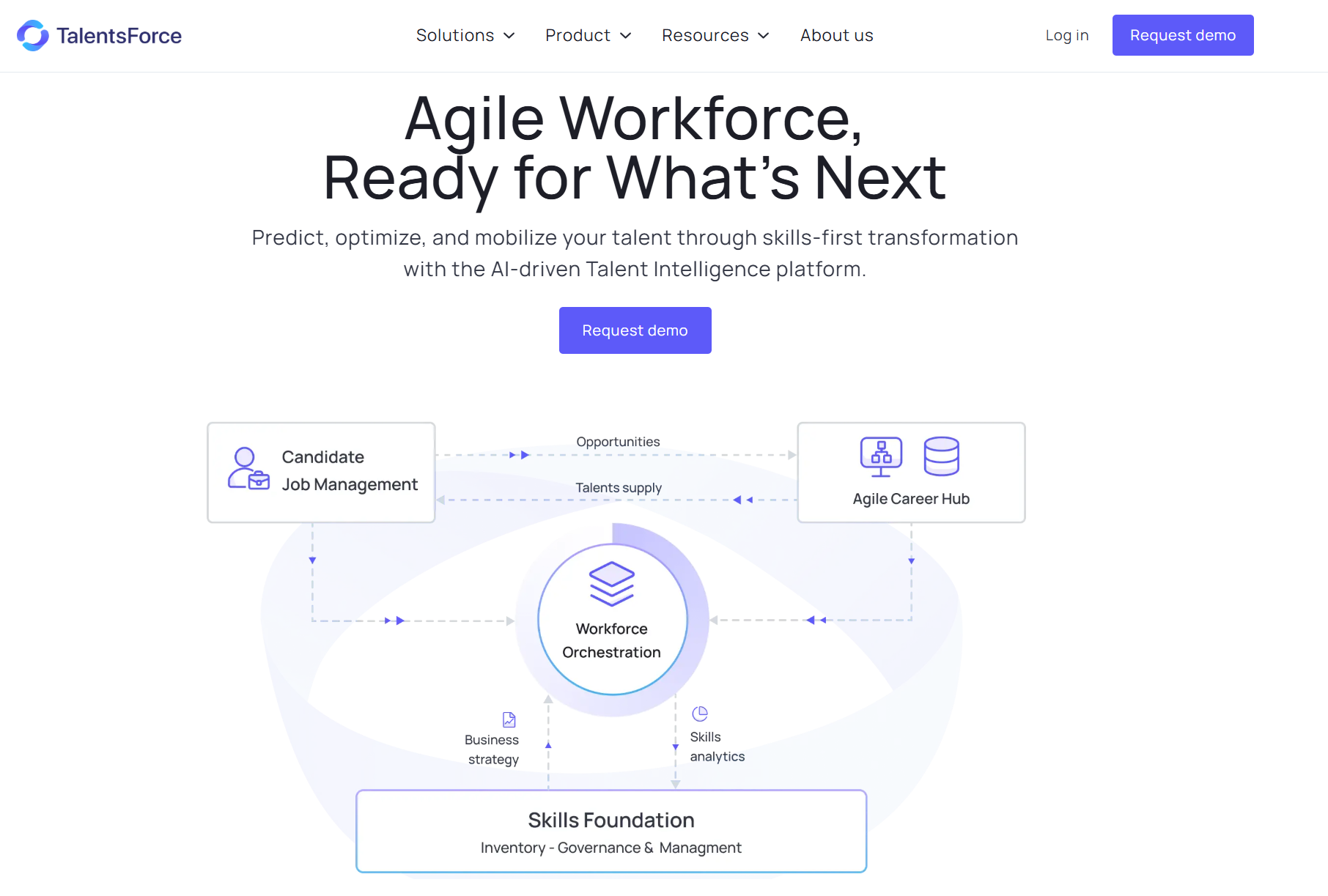
TalentsForce represents a fundamental evolution beyond traditional applicant tracking systems. While most ATSs focus exclusively on external hiring workflows, TalentsForce provides a comprehensive talent intelligence platform built on a central Skills Foundation that connects recruiting, internal mobility, career development, and workforce planning in one ecosystem.
This architectural difference addresses a critical gap in traditional recruitment technology: fragmented workforce data that prevents organizations from seeing the complete picture of talent capabilities. By standardizing skills across job postings, employee profiles, and learning programs, TalentsForce enables businesses to make talent decisions based on unified intelligence rather than disconnected systems.
Why TalentsForce leads in 2026
The platform's distinctive value emerges from four integrated pillars that work together rather than as separate modules:
Skills Foundation provides the intelligence layer that standardizes organizational skills through a central taxonomy. The Skill Inventory creates a structured record of capabilities across the workforce, enabling real-time visibility into skills supply and demand. This foundation connects all talent decisions through consistent data rather than fragmented spreadsheets and disconnected tools.
Career in Motion powers employee-driven growth through Career Navigator AI, which generates personalized career paths by analyzing employee profiles, organizational role requirements, and skill gaps. The Agile Career Hub functions as an internal marketplace where employees discover roles, projects, and mentorship opportunities aligned to their capabilities and aspirations. This reduces turnover while building internal talent pipelines that decrease dependency on external hiring.
Intelligence in Action delivers strategic workforce analytics through real-time monitoring of organizational capabilities, market benchmarking, and predictive insights for future needs. Leaders gain visibility into skills gaps before they impact business operations, enabling proactive deployment rather than reactive backfilling.
Talent Acquisition executes hiring operations through comprehensive ATS functionality, including Jobs Management, Interview Management, and Sourcing Tools. Gen AI capabilities automate CV parsing across multiple formats with contextual understanding, generate job descriptions aligned to skills requirements, and summarize candidate profiles for faster evaluation.
Key differentiating features
- Position Management connects required skills to organizational roles, ensuring accurate career path recommendations and effective skills gap analysis throughout the talent lifecycle.
- Career Navigator AI generates actionable development recommendations based on employee goals, current capabilities, and target roles within the organization.
- Learning Management System links courses directly to skills, automatically updating employee profiles upon completion to maintain current capability records.
- Boolean Search enables rapid access to jobs, candidates, and company information from a single search interface, eliminating time spent navigating multiple screens.
- Talent Pool functionality stores and nurtures potential candidates for future needs, building sustainable talent pipelines that reduce time-to-hire and cost-per-hire metrics.
- Interview Kits standardize evaluation through pre-defined guidelines, questions, and scoring criteria that reduce bias and improve hiring consistency.
Who benefits most from TalentsForce
Organizations operating in high-growth markets, particularly IT, biotech, and finance companies with in-house HR teams and recruitment professionals managing increased application volumes while seeking strategic workforce insights. Companies that need both external hiring capabilities and internal talent development tools without implementing separate systems find particular value in the unified platform approach.
Integration and ecosystem
Current integration capabilities include calendar synchronization for interview scheduling, with the platform designed to connect with broader HR technology stacks as organizations scale. The system's skills-based architecture allows data to flow between recruiting, learning, and workforce planning functions without manual reconciliation.
What users appreciate
Recruitment teams value the Gen AI tools that reduce time spent formatting CVs and writing job descriptions. HR leaders gain workforce visibility previously unavailable without enterprise HCM platforms. Employees appreciate personalized career guidance that connects their aspirations to concrete development actions. The unified approach eliminates context-switching between separate systems for hiring, mobility, and planning.
2. Greenhouse: Structured hiring for enterprise organizations
Best for: Large enterprises focused on structured interview processes and bias reduction
Company overview
Greenhouse has built its reputation on the principle that great hiring requires structure. The platform enforces standardized evaluation criteria across hiring teams, making it particularly valuable for organizations committed to reducing bias and improving hiring consistency at scale.
Key features
- Structured hiring methodology with mandatory scorecards for every interview stage
- Comprehensive bias reduction tools including anonymized resume screening
- Integration ecosystem exceeding 300 applications across HR technology landscape
- Advanced analytics tracking hiring funnel metrics and source effectiveness
- Compliance management for regulated industries with audit trail documentation
Strengths
Organizations implementing structured hiring processes see measurable improvements in candidate quality and hiring manager satisfaction. The platform's focus on standardization makes it effective for companies managing hundreds of recruiters across multiple locations who need consistent evaluation frameworks.
Considerations
The structured approach requires organizational commitment to defined processes. Companies seeking flexibility to adapt workflows frequently may find the system's rigidity constraining. Implementation timeline and cost position Greenhouse as an enterprise-focused solution rather than mid-market option.
Pricing
Custom enterprise pricing based on company size and feature requirements, typically positioning in the upper tier of ATS investments.
3. Lever: Talent acquisition platform with built-in CRM
Best for: Organizations emphasizing relationship-based recruiting and candidate nurturing
Company overview
Lever combines traditional ATS functionality with customer relationship management capabilities, enabling recruiters to build and maintain talent relationships over time. This hybrid approach supports proactive sourcing strategies beyond reactive job posting.
Key features
- Integrated CRM for managing candidate relationships and talent pipeline development
- AI-powered candidate matching that prioritizes candidates based on multiple factors beyond keyword matching
- Automated interview summaries and transcriptions for streamlined feedback collection
- Extensive integration options connecting with existing technology stacks
- Real-time analytics tracking recruitment velocity and pipeline health
Strengths
The CRM functionality differentiates Lever for teams building proactive talent communities. Organizations report 34% faster job posting, 22% faster offer delivery, and 33% improvement in application quality according to independent studies. The platform particularly serves companies where relationship development drives recruiting success.
Considerations
The combined ATS-CRM model requires recruiters to adopt different workflows than traditional applicant tracking alone. Organizations without dedicated sourcing teams may not fully utilize the CRM capabilities that justify the platform's positioning.
Pricing
Mid-to-high tier pricing with custom quotes based on organizational requirements and user count.
4. Workable: User-friendly platform for growing companies
Best for: Small to mid-sized organizations prioritizing ease of use without sacrificing capability
Company overview
Workable has earned recognition for delivering comprehensive recruiting functionality through an exceptionally intuitive interface. Serving over 27,000 companies worldwide, the platform balances power with simplicity, making it accessible for teams without dedicated recruiting specialists.
Key features
- Clean, intuitive interface requiring minimal training for new users
- AI-powered tools for job distribution across multiple channels simultaneously
- Comprehensive sourcing capabilities including social media and job board integration
- Native mobile applications enabling full recruiting functionality from smartphones
- Built-in video interviewing eliminating need for separate tools
Strengths
Organizations consistently rank Workable among the most user-friendly platforms available. The system includes advanced features like candidate relationship management and people analytics while maintaining interface simplicity that reduces onboarding time and increases team adoption.
Considerations
Companies requiring highly customized workflows or deep integration with complex enterprise systems may find Workable's simplified approach limiting. The platform serves growing companies exceptionally well but may not scale to enterprise complexity requirements.
Pricing
Transparent pricing tiers starting at accessible levels for small businesses, scaling based on user count and feature requirements.
5. iCIMS Talent Cloud: Enterprise-scale recruiting infrastructure
Best for: Large organizations with complex, multi-location recruiting requirements
Company overview
iCIMS Talent Cloud provides enterprise-grade recruiting infrastructure designed to handle thousands of positions and recruiters simultaneously. The platform prioritizes scalability, compliance, and global operations support.
Key features
- Enterprise-level scalability supporting organizations with 500+ recruiters
- Advanced AI for candidate screening and automated interview coordination
- Global compliance management across multiple regulatory jurisdictions
- Comprehensive analytics providing leadership visibility into recruiting operations
- Extensive customization capabilities for complex organizational requirements
Strengths
Organizations managing recruiting at scale benefit from iCIMS' robust infrastructure that maintains performance regardless of hiring volume. The platform handles complexity that would overwhelm smaller systems, particularly for companies operating across multiple countries with varying compliance requirements.
Considerations
Implementation timeline extends longer than mid-market solutions due to customization and integration complexity. The system's enterprise focus means smaller organizations may pay for capabilities they don't require. Interface complexity increases alongside feature depth.
Pricing
Premium enterprise pricing reflecting the platform's comprehensive capabilities and implementation support requirements.
6. BambooHR: Integrated HR suite with built-in recruiting
Best for: Small to mid-sized businesses seeking combined HR management and applicant tracking
Company overview
BambooHR differentiates by combining full HR management capabilities with applicant tracking, creating seamless data flow from candidate application through employee onboarding and ongoing HR administration.
Key features
- Unified platform connecting recruiting, onboarding, time tracking, and benefits administration
- Simplified reporting and analytics accessible for HR generalists without specialized training
- Mobile applications for both candidates and employees throughout the employment lifecycle
- Built-in e-signatures and document management for streamlined offer acceptance
- Employee self-service portal extending recruiting transparency into ongoing employment
Strengths
The integrated approach eliminates duplicate data entry and disconnected systems between recruiting and HR functions. Organizations appreciate consistent experience for candidates becoming employees, with application data automatically flowing into HR records.
Considerations
Companies needing sophisticated recruiting capabilities may find BambooHR's ATS functionality less robust than specialized platforms. The system excels for organizations seeking adequate recruiting tools within comprehensive HR management rather than best-in-class applicant tracking alone.
Pricing
Subscription pricing based on employee count with recruiting module included in core plans, making it cost-effective for organizations needing both HR and recruiting capabilities.
7. JazzHR: Budget-friendly solution for small businesses
Best for: Startups and small businesses implementing their first applicant tracking system
Company overview
JazzHR delivers essential recruiting functionality at accessible price points, making professional applicant tracking available to organizations previously relying on email and spreadsheets.
Key features
- Core ATS functionality including job posting, candidate tracking, and interview scheduling
- Job board syndication distributing openings across multiple sites simultaneously
- Customizable workflows adapting to various hiring processes
- Collaboration tools enabling hiring manager participation in evaluation
- Basic reporting covering fundamental recruiting metrics
Strengths
The platform removes cost barriers preventing small businesses from implementing professional recruiting processes. Implementation requires days rather than months, and intuitive design minimizes training requirements. Organizations gain structured hiring without enterprise complexity or investment.
Considerations
Advanced features like sophisticated analytics, AI-powered screening, or complex workflow automation available in premium platforms are limited. Companies anticipating rapid growth may outgrow JazzHR's capabilities as recruiting volume increases.
Pricing
Transparent, budget-friendly pricing tiers starting under $100 monthly, making professional ATS accessible for small teams.
8. Recruitee: Collaborative hiring for distributed teams
Best for: Remote-first organizations emphasizing team collaboration in hiring decisions
Company overview
Recruitee focuses on collaborative hiring workflows that enable distributed teams to participate effectively in candidate evaluation regardless of location. The platform prioritizes transparency and communication across hiring stakeholders.
Key features
- Team collaboration tools facilitating feedback collection and hiring decision coordination
- Customizable workflows accommodating diverse hiring processes across departments
- Candidate relationship management for maintaining talent pipeline engagement
- Career site builder creating branded application experiences
- Analytics dashboards tracking team performance and process efficiency
Strengths
Organizations with multiple stakeholders in hiring decisions appreciate the structured collaboration features that prevent feedback bottlenecks. The system works particularly well for remote teams needing asynchronous participation in candidate evaluation.
Considerations
Companies seeking cutting-edge AI capabilities or deep integration with enterprise systems may find Recruitee focused more on collaboration workflows than advanced automation. The platform serves team coordination needs exceptionally well without positioning as a technology innovation leader.
Pricing
Mid-tier pricing based on active jobs and user count, positioning as accessible for growing companies without enterprise budgets.
How to choose the right applicant tracking system for your organization
Selecting from the numerous ATS options requires systematic evaluation aligned to your specific requirements rather than pursuing the most feature-rich or heavily marketed platform. Consider these critical factors:
Organization size and growth trajectory
Systems designed for startups handle different volumes and complexity than enterprise platforms. Evaluate not only your current state but anticipated growth over 24-36 months. Migrating between ATS platforms disrupts recruiting operations significantly, making it worthwhile to select systems with room to scale.
Recruiting complexity and volume
Organizations hiring occasionally for straightforward roles require different capabilities than companies managing hundreds of positions simultaneously across multiple departments and locations. Match platform sophistication to your actual workflow complexity rather than paying for unused enterprise features.
Skills-based hiring priorities
If your talent strategy emphasizes skills over traditional qualifications, prioritize platforms with robust skills frameworks, assessment integration, and capability mapping. Systems built around job titles and resume keyword matching will require workarounds to implement skills-based approaches effectively.
Internal mobility and workforce planning needs
Traditional ATS platforms focus exclusively on external hiring. Organizations seeking to build internal talent pipelines, enable career development, or gain workforce analytics require platforms connecting recruiting with broader talent intelligence like TalentsForce's integrated approach.
Integration requirements
Evaluate how the ATS will connect with your existing HR technology stack including HRIS, learning management systems, background check providers, and job boards. Platforms offering pre-built integrations reduce implementation complexity and ongoing maintenance burden.
Budget and total cost of ownership
Beyond subscription pricing, consider implementation costs, ongoing support requirements, training needs, and costs of integrations or customizations. Some platforms with lower subscription fees require significant additional investment to achieve full functionality.
Compliance and security requirements
Organizations in regulated industries or handling sensitive candidate data require platforms with appropriate security certifications, compliance features, and audit trail capabilities. Verify the system meets your specific regulatory requirements before committing.
User experience for recruiters and candidates
Systems with complex interfaces reduce team adoption and productivity. Similarly, clunky candidate experiences damage employer brand and reduce application completion rates. Prioritize platforms balancing capability with usability for both internal users and applicants.
Key trends shaping applicant tracking systems in 2026
Understanding broader market trends helps contextualize platform capabilities and anticipate future developments:
Skills-first architecture becomes standard - The shift from resume-based to skills-based hiring continues accelerating, with 85% of employers now implementing skills-focused practices. Platforms built around skills taxonomies rather than job titles gain strategic advantage as organizations recognize skills visibility enables workforce agility.
AI moves from automation to intelligence - Beyond automating routine tasks, AI now provides predictive insights about candidate success, identifies transferable skills that humans might miss, and generates sophisticated recommendations for talent deployment. The focus shifts from replacing human judgment to amplifying it through better information.
Internal and external talent management converges - Organizations recognize that building skills, enabling mobility, and strategic workforce planning cannot be separated from recruiting. Platforms connecting internal and external talent management, like TalentsForce, reflect this integration where hiring decisions consider existing workforce capabilities.
Candidate experience drives differentiation - With unemployment rising and talent markets stabilizing, candidates have more choices. Organizations differentiate through transparent communication, mobile-optimized processes, personalized engagement, and efficient timelines. ATS platforms enabling superior candidate experiences provide competitive recruiting advantages.
Compliance and bias reduction become non-negotiable - Regulatory requirements around pay transparency, diversity reporting, and fair hiring practices continue expanding. Systems with built-in compliance management and bias reduction tools transform from nice-to-have features to business necessities.
Making your final decision
The best applicant tracking system for your organization aligns with your specific talent acquisition strategy, organizational size, and growth objectives. For mid-market businesses seeking unified talent intelligence that connects recruiting with internal mobility and workforce planning, TalentsForce provides comprehensive capabilities typically fragmented across multiple systems.
Organizations prioritizing structured hiring and bias reduction at enterprise scale should evaluate Greenhouse. Teams emphasizing relationship-based recruiting benefit from Lever's CRM integration. Companies seeking user-friendly simplicity find value in Workable. Small businesses implementing their first ATS often start with JazzHR's accessible pricing.
Rather than pursuing the most comprehensive feature list, identify the 3-5 capabilities most critical for your recruiting success and prioritize platforms excelling in those specific areas. Request demonstrations focused on your actual workflows rather than generic presentations. Involve recruiters, hiring managers, and candidates in evaluation to ensure the system serves all stakeholders effectively.
The applicant tracking system you select becomes central infrastructure for talent acquisition, influencing every hire your organization makes. Invest appropriate time in evaluation, verify vendor claims through reference conversations with similar organizations, and ensure the platform supports your talent strategy rather than constraining it.
Frequently asked questions
What is an applicant tracking system?
An applicant tracking system (ATS) is software that organizations use to streamline recruitment processes by managing job postings, tracking candidate applications, facilitating communication, and organizing hiring workflows. Modern ATS platforms extend beyond basic tracking to include AI-powered screening, skills-based matching, interview coordination, and recruiting analytics.
How much does an applicant tracking system cost?
ATS pricing varies dramatically based on organization size, feature requirements, and implementation complexity. Small business solutions start under $100 monthly, mid-market platforms typically range from $300-$1,000 monthly, and enterprise systems require custom pricing often exceeding $20,000 annually. Consider total cost of ownership including implementation, training, and integration expenses beyond subscription fees.
Can applicant tracking systems reduce hiring bias?
Yes, when properly configured. Modern ATS platforms include bias reduction features like anonymized resume screening, standardized evaluation criteria, diverse candidate sourcing tools, and analytics tracking diversity metrics throughout hiring funnels. However, technology alone cannot eliminate bias—it requires organizational commitment to structured processes and ongoing monitoring of outcomes.
What is skills-based hiring and which ATS platforms support it?
Skills-based hiring evaluates candidates based on demonstrated capabilities rather than traditional qualifications like degrees or job titles. This approach widens talent pools and improves hiring outcomes. Platforms like TalentsForce build their entire architecture around skills frameworks, while others like Greenhouse and Lever incorporate skills assessment integration. Look for systems with skills taxonomy management, assessment tools, and capability mapping beyond keyword matching.
How long does it take to implement an applicant tracking system?
Implementation timelines range from one week for simple, small-business platforms to 6-12 months for complex enterprise systems. Mid-market solutions typically require 4-8 weeks including data migration, integration setup, customization, and team training. Choose platforms matching your available resources and urgency—rapid deployment often means accepting standard configurations while extensive customization extends timelines.
Should we choose an all-in-one HR platform or specialized ATS?
This depends on your HR technology strategy. All-in-one platforms like BambooHR provide adequate recruiting capabilities within comprehensive HR management, eliminating integration challenges between hiring and employee management. Specialized ATS platforms offer more sophisticated recruiting features but require integration with separate HRIS. Mid-market organizations often benefit from specialized solutions that grow with recruiting complexity, while small businesses appreciate unified platforms reducing system management overhead.
What metrics should we track in our applicant tracking system?
Essential recruiting metrics include time-to-hire (days from job opening to offer acceptance), time-to-fill (days until position is actually filled), cost-per-hire, source effectiveness (which channels generate best candidates), candidate drop-off rates at each stage, quality-of-hire scores, and diversity metrics. Advanced systems like TalentsForce additionally track skills supply and demand, internal mobility rates, and workforce readiness for strategic planning.
The applicant tracking systems landscape in 2026 offers unprecedented capability to organizations of all sizes. Whether you're implementing your first structured recruiting process or upgrading enterprise infrastructure, platforms now available provide AI-powered intelligence, skills-based matching, and strategic workforce insights that transform hiring from an administrative necessity to a competitive advantage. Evaluate options against your specific requirements, involve key stakeholders in selection, and choose systems that amplify your talent acquisition strategy rather than constraining it.


