AI CV stands for AI-generated CV (Curriculum Vitae), a document that candidates submit to employers at the beginning of the job application process. AI is being used as a support tool to help candidates format, write and present their CVs.
AI CVs make the candidates application look polished and closely aligned to job descriptions, but they also make CVs less distinctive and less reliable for screening. Because AI-generated CVs can be optimized to keywords without proving real skills, recruiters need to rely more on skills-based hiring to see who can actually perform the job.
Recruiters are spending 20–30% more time screening candidates this year (TalentsForce internal data). AI tools now help applicants produce polished CVs that align closely with job descriptions. When CVs become more similar, they provide less signal about who can perform the job.
This creates a recruiter workflow problem: AI CV tools increase volume and polish, while reducing the reliability of CV-based screening. A skills-based hiring workflow helps restore a clear signal by shifting the assessment from CV presentation to demonstrated capability.
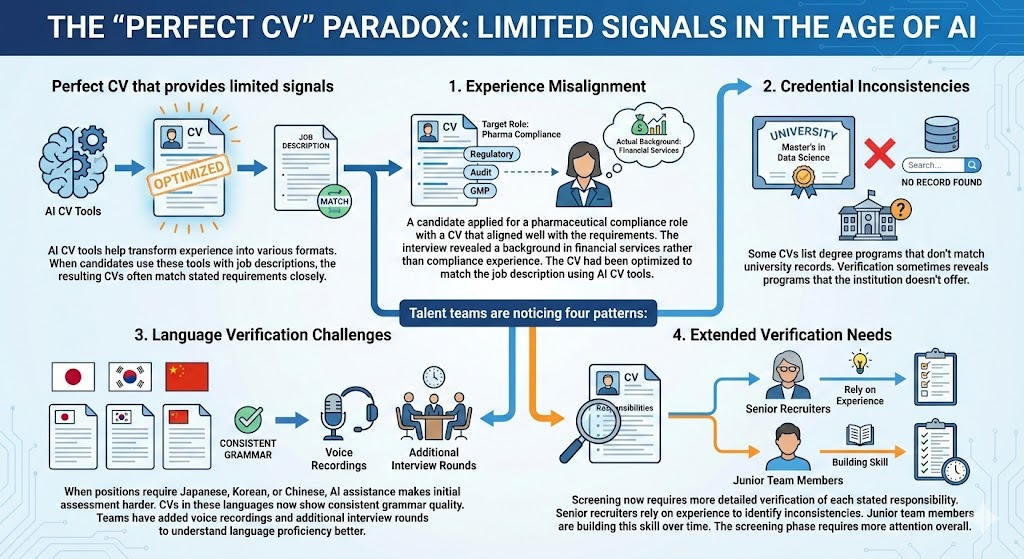
Perfect CV that provides limited signals
AI CV tools help transform experience into various formats. When candidates use these tools with job descriptions, the resulting CVs often match stated requirements closely.
Talent teams are noticing four patterns:
Experience misalignment
A candidate applied for a pharmaceutical compliance role with a CV that aligned well with the requirements. The interview revealed a background in financial services rather than compliance experience. The CV had been optimized to match the job description using AI CV tools.
Credential inconsistencies
Some CVs list degree programs that don't match university records. Verification sometimes reveals programs that the institution doesn't offer.
Language verification challenges
When positions require Japanese, Korean, or Chinese, AI assistance makes initial assessment harder. CVs in these languages now show consistent grammar quality. Teams have added voice recordings and additional interview rounds to understand language proficiency better.
Extended verification needs
Screening now requires more detailed verification of each stated responsibility. Senior recruiters rely on experience to identify inconsistencies. Junior team members are building this skill over time. The screening phase requires more attention overall.
Why AI CV detection has limitations
Some organizations consider AI detection tools. This addresses a symptom rather than the underlying recruiter workflow challenge.
The situation reflects recruiting processes that rely heavily on a document type that has become less distinctive. Rather than trying to restore the document's reliability with AI CV detection, consider adjusting how much weight it carries in decisions.
Skills-based hiring provides clearer signals
As AI CV tools make resumes look increasingly similar, skills-based hiring becomes more predictive of job success than CV review alone, as demonstrated through
- Five times stronger prediction of job performance compared to education-based screening
- More than twice the accuracy compared to work experience review alone
- Improved retention as decisions reflect demonstrated capability
- Broader talent pools as evaluation emphasizes demonstrable skills
Three recruiter workflow adjustments for the AI CV era
1. Define skills before writing job descriptions
Identify 3–5 core skills the role needs. Make them specific, connected to performance outcomes, and assessable through demonstration.
This clarity is the foundation of a skills-based hiring workflow that does not over rely on AI CV formats.
2. Include skills-based questions in applications
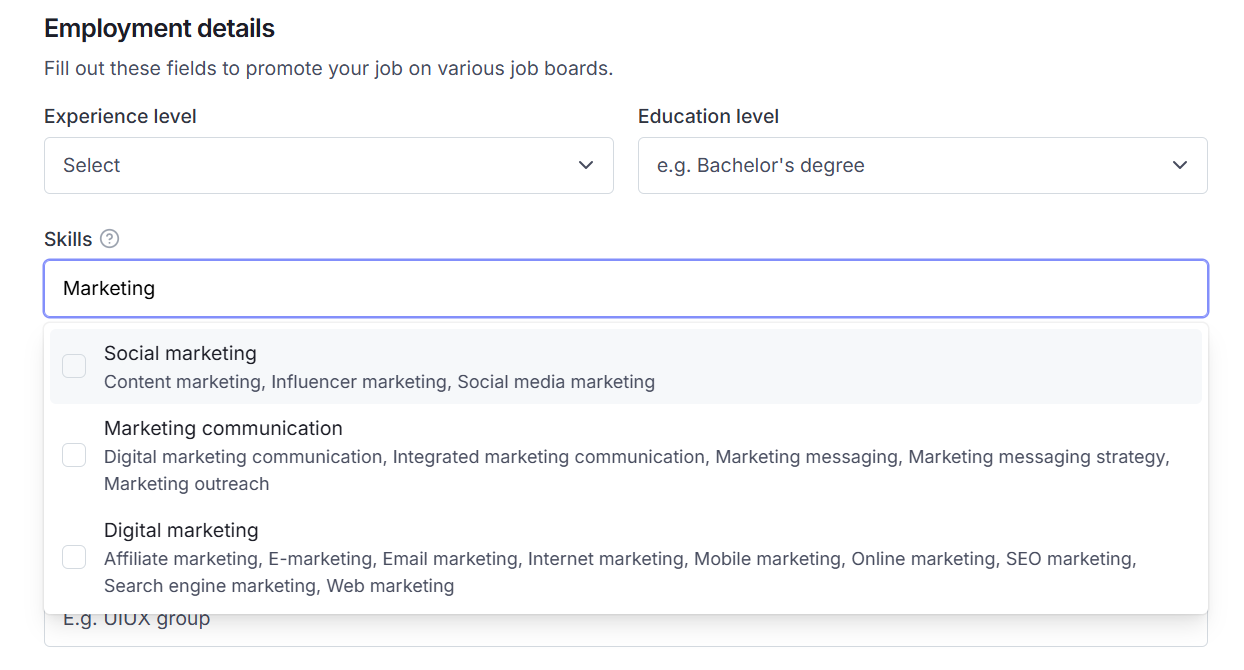
Add 1–2 brief questions asking candidates to describe their approach to realistic situations. These responses reveal thinking patterns that provide reliable signals.
Useful questions present scenarios candidates would encounter, ask for specific approaches, invite reasoning and explanation, and allow assessment of problem-solving capability.
3. Use structured skills-based assessment
Create a scoring guide for your defined skills. All reviewers apply the same criteria.
Define what each skill level means for this role specifically. Reviewers assess against this guide, creating consistency across the team and strengthening the skills-based hiring process.

How skills-based hiring works with AI CVs in practice
- Application: Candidates see skills-focused job descriptions. Applications include skills-based questions. CVs, including AI CV formats, provide additional context but aren't the primary assessment tool.
- Initial review: Recruiters assess answers using structured scoring. CVs offer background information. Advancement decisions come from demonstrated thinking in responses.
- Interview: Questions explore the defined skills more thoroughly, building on application responses. The same assessment framework continues.
- Decision: Teams compare skills assessments rather than primarily comparing credentials. This creates clearer discussions and more consistent outcomes.
A broader shift
The current landscape emphasizes the importance of skills in hiring, highlighting that CVs have always showcased presentation alongside experience.
While some teams focus on CV verification, others are shifting towards skills-based evaluations, which enhance predictive accuracy in hiring.
The key isn't more intensive CV analysis but rather reducing the influence of CV reviews and focusing on demonstrated skills within a skills-based hiring framework.
Contact TalentsForce team to learn how we help recruiters and HR apply skills-based hiring process with our platform.